GoldieBench Blog · 12 min read
The Best UI For Hermes Agent In 2026: Seven Interfaces Ranked, Then The Models To Run Behind Them
The best UI for Hermes Agent, for me, is my own Agent OS, then Hermes Desktop. See 7 ranked, how to set each up, and which model to run behind it.
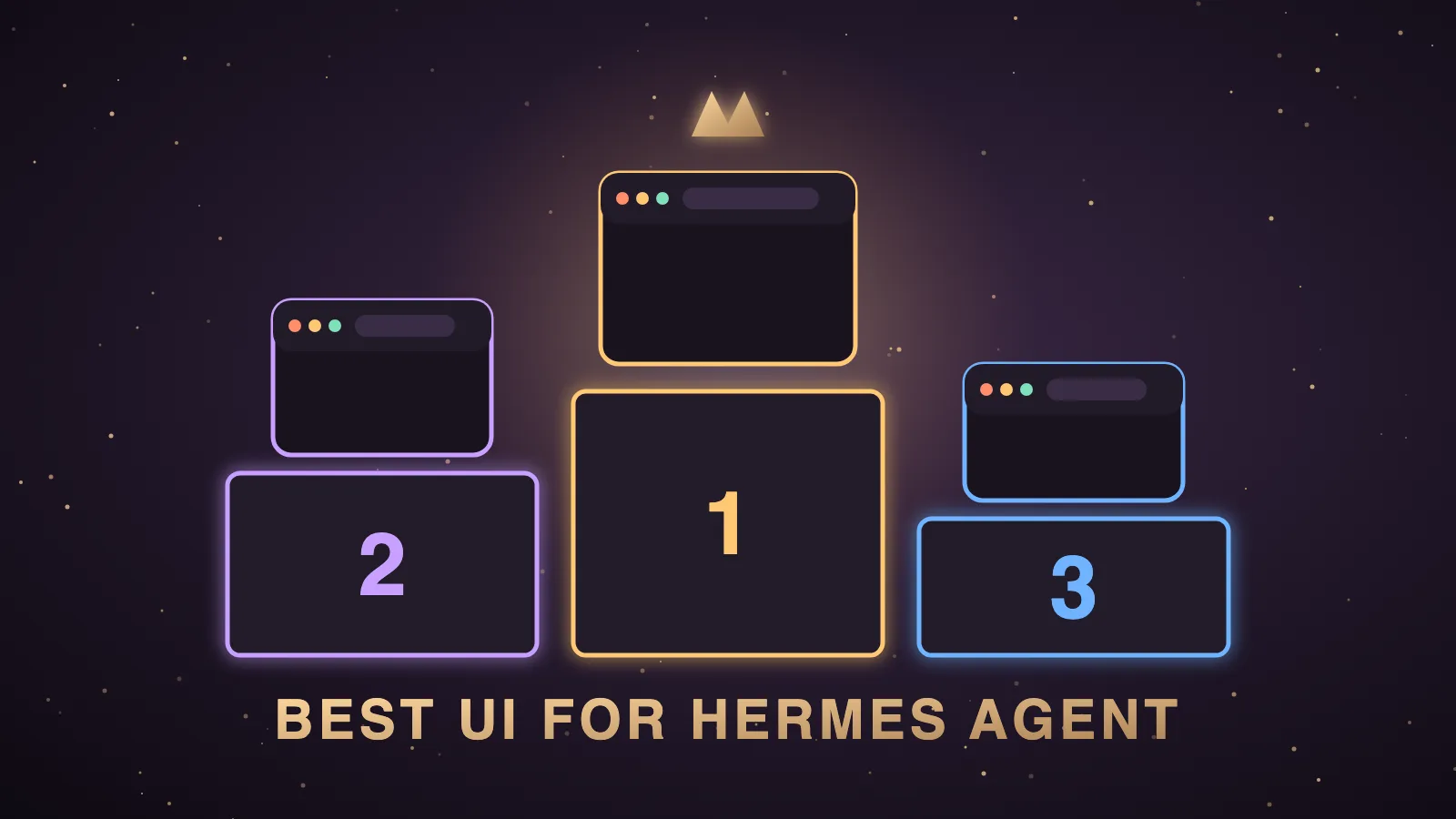
The best UI for Hermes Agent in 2026, for my own daily work, is my Agent OS, which is one dashboard where Hermes, Claude and my other agents share a single memory.
It is my own product, so weigh that when you read this list.
Hermes Desktop is my second pick and the best free one, and Herald OS is third because it is the best-looking Hermes front-end I have used.
A UI for Hermes Agent is simply a screen that sits on top of Hermes Agent, so you can chat with it and manage it without typing commands.
I'll give you the ranked list first, then how each one works and how to set it up, then the limits, and finally the real bench scores for the models you can run behind them.
The top three picks for the best UI for Hermes Agent
- 🥇 Agent OS is my daily pick, because it is one cockpit for Hermes, Claude and my other agents, and it is my own product inside the AI Profit Boardroom.
- 🥈 Hermes Desktop is the best free pick, because it is official, free and stable.
- 🥉 Herald OS is the best-looking, with Spaces, Missions and a morning dashboard, but it is an alpha.
What a UI for Hermes Agent is and why it matters
Hermes Agent is the free, open-source AI agent from Nous Research.
It can use tools, run scheduled jobs, remember what it learns and answer on messaging apps.
It started in the terminal, and a UI gives that same agent a proper window.
The official docs say all the front-ends talk to the same agent and share state, so a session you start in one can be resumed in another.
That means choosing an interface is a low-risk decision, because you can switch at any time.
It also means the screen and the model are two separate choices, which is why this page ends with bench scores.
Why my Agent OS is first here and unranked in my other list
I have already published my earlier ranking of the free Hermes UIs, and Hermes Desktop came first in it.
In that post I left my own Agent OS out of the ranking, and I wrote that I would rather be upfront than rank myself first in my own list.
I still think that was right for a list of free downloads.
This page answers a different question, which is what I actually use every day.
The honest answer is my Agent OS, so hiding it would be less truthful than naming it.
So that list ranks free downloads, and this list ranks my daily driver with a clear disclosure.
Hermes Desktop is the best free pick in both.
How I ranked the best UI for Hermes Agent options
I ranked every interface on four things.
The first is how much of my working day I spend in it.
The second is how quickly you can install it and send a first message.
The third is how much of Hermes you can control from it.
The fourth is how stable it felt when I used it.
These are my own first-person picks and not measured scores, and one entry is included from its documentation only.
The seven best UI options for Hermes Agent, ranked
| Rank | Interface | Who makes it | Cost | Best for | Main limit |
|---|---|---|---|---|---|
| 1 | Agent OS | Me (my own product) | Included with AI Profit Boardroom membership | Hermes plus Claude and other agents on one screen | It is not free, and it is not on public GitHub |
| 2 | Hermes Desktop | Nous Research (official) | Free | Most people starting free | It runs Hermes only, and voice permissions were hit and miss on my Mac in June |
| 3 | Herald OS | Luke The Dev (independent) | Free | The nicest look and separate Spaces | It is an alpha, and Connections did not sync for me |
| 4 | Hermes WebUI | nesquena (community) | Free | Browser and phone access | You secure remote access yourself |
| 5 | Hermes Workspace | outsourc-e (community) | Free | A free kanban board and inspector | It needs the gateway and dashboard running |
| 6 | Terminal and TUI | Nous Research (built in) | Free | Developers and servers | It is the least friendly for beginners |
| 7 | Hermes3D | LukeTheDev (independent, unofficial) | Free | Watching a team of agents in a 3D office | I have not tested it, and it has one release |
How each UI for Hermes Agent works and how to set it up
1. Agent OS (my own product)
My Agent OS is a local dashboard where every agent I use is a page in one app.
The home page is Mission Control, and it shows the live status of every agent and what happened since I last looked.
Each agent has its own section with a chat panel, a file workspace and a control room.
Mine has seven agents wired in, which are Claude Code, OpenClaw, Hermes, Antigravity, Codex, Gemini and Free Claude Code.
Hermes sits behind thirteen rooms, which are Chat, Apollo voice, Oracle, Astros, Studio, Sessions, Outreach, Mixture, Workspace, MCPs, Manage, Control Room and Goal Mode.
I can type in the chat, say "hey Hermes" out loud or drop a ticket on the kanban board, and it is the same agent with the same memory.
Spoken answers come back in about five seconds, and they are written into the same chat thread.
Every Hermes profile on the machine appears as a chip in the chat, and each chip has its own model, memory and rules.
Every exchange saves into an Obsidian vault of plain text files, which every agent reads before it works.
The Manage room embeds the full Hermes dashboard, so sessions, models, cron jobs and skills need no terminal.
To set it up, you join the AI Profit Boardroom, download the installable zip and follow the install video, with Hermes Agent already installed.
It is not on public GitHub, and I explain why in my post on the Agent OS and GitHub.
If you would rather build your own for free, my Agent OS build guide gives you the seven prompts in order.
2. Hermes Desktop
Hermes Desktop is the native app built on the same agent core, config, keys, sessions, skills and memory as the command line.
It gives you streaming chat, a side-by-side preview rail, a file browser, voice, cron, profiles, skills and settings.
If Hermes is already installed, you run hermes desktop and it launches against your existing setup.
If it is not, you download the installer for macOS on Apple Silicon, Windows or Linux from the Hermes Desktop page.
It also has a plugin marketplace, where I found around 500 free community plugins with a one-click install.
3. Herald OS
Herald OS is an agent-native operating system with Hermes Agent as the interface, and it is not affiliated with Nous Research.
Its dashboard greets you, shows today's schedule and offers a "Pick up where you left off" card.
Spaces split your work into Ideas, Work and Personal, and Missions let Hermes plan a goal step by step.
On a Mac you need macOS 13 or later on Apple Silicon, and you install Hermes first and then download Herald OS from its GitHub releases page.
The build is not notarised yet, so you run one xattr command before it opens.
Honestly, I think it looks nicer than Hermes Desktop, and my full walkthrough is in my Herald OS post.
4. Hermes WebUI
Hermes WebUI is a lightweight browser app with sessions on the left, chat in the middle and a workspace file browser on the right.
It is plain Python and JavaScript, so there is no build step.
You clone the repository, run python3 bootstrap.py, and reach it from other devices through an SSH tunnel or Tailscale.
5. Hermes Workspace
Hermes Workspace is a browser command centre with chat, memory, skills, files, a terminal and a kanban task board.
Its one-line installer sets it up, and you then run hermes gateway run and pnpm dev and open localhost on port 3000.
Version 2 added profiles, a live inspector and an editable memory browser, and I have used its kanban board as an AI to-do list.
6. The terminal and the TUI
The terminal is the baseline, and you start the modern terminal UI with hermes --tui.
The docs call the TUI the recommended way to run Hermes interactively, and it costs nothing.
7. Hermes3D (unofficial, and I have not tested it)
Hermes3D is a 3D virtual office for AI agents that you run on your own infrastructure, built by LukeTheDev.
I have not installed it, so this section comes from its GitHub README and not from my own testing.
The README says it is an independent, community-driven front-end that is not affiliated with the teams behind the agent backends it connects to.
It describes a live 3D office where you watch agents work, run standups and review pull requests, plus a 2D pixel office for low-power machines.
The README's quick start is to clone the repository, run npm install, copy .env.example to .env, run npm run dev and open localhost on port 3000.
It asks for Node.js 20 or later, and it does not install Hermes for you.
My docs-based explainer is in the Hermes3D guide.
How Hermes fits into my Agent OS day to day
I mostly live in two rooms, which are chat and voice.
Bigger jobs become tickets on the board instead of long prompts.
A dispatcher starts a Hermes worker for each ticket, and the worker drives the build while I do something else.
In my Hermes Command Desk guide, three tickets went to done that way, which were a landing page, a content kanban app and an analytics dashboard.
Those three builds ran on free models.
I create a board for that with hermes kanban boards create my-builds.
I also keep a named Hermes agent called Oracle, which checks competitors' sites and news each morning and writes a report into the vault.
The same dashboard opens on my phone through Tailscale, which builds a private network between my own devices.
If you care more about screens that show sessions, costs and tasks, read my Hermes Agent dashboards roundup.
The honest limits of every UI for Hermes Agent
My Agent OS is my own product, it needs a membership, and it is not a free download.
It runs on my own machine, so my home internet is the speed limit when I travel, and a power cut at home means waiting.
Hermes Desktop is the safest free pick, but it only runs Hermes, and voice permissions were hit and miss on my Mac when I tested them in June.
Herald OS is an alpha, its Connections page did not sync for me, and the top of the interface was slightly cut off on my screen.
Hermes WebUI and Hermes Workspace are community projects, so you keep them updated yourself.
The terminal is fast, but most beginners will not enjoy it.
Hermes3D is unofficial and untested by me, and its repository shows one release from August 2026 and no pushes since late August.
The repository's short About line also calls it a 3D engine for games and simulations, while the README describes an office for agents.
Whichever you choose, check the Memory page before you share your screen, because I once spotted my Telegram details in mine.
Which UI for Hermes Agent should you pick?
Pick Hermes Desktop if you are new and want one free, stable app.
Pick an Agent OS if you run Hermes next to Claude or other agents and want one screen and one memory.
Pick Herald OS if looks matter and you can live with alpha rough edges.
Pick Hermes WebUI or Hermes Workspace if your agent lives on a server.
Pick the terminal for speed, and treat Hermes3D as an experiment until you have tested it.
If you want the whole stack ranked, read the best Hermes Agent setup.
No UI for Hermes Agent ships its own model, so pick the brain
Here is the part most interface lists skip.
Not one of these interfaces comes with its own model, because each one runs whatever model your Hermes install is connected to.
That includes my Agent OS, where every Hermes profile chip points at a model I chose.
A beautiful dashboard does not make Hermes smarter.
If the brain is weak, tickets come back broken, however nice the board looks.
Hermes needs a model provider, which can be a Nous Portal account or an API key for OpenRouter, OpenAI, Anthropic or a local model.
So I use GoldieBench to compare the brains, and I use my own daily use to judge the interface.
The strongest brains to run behind a UI for Hermes Agent
These are live averages from the board on 14 October 2026, and each model link opens its full page.
| Model | Live avg | Tasks scored | Why it suits a Hermes interface |
|---|---|---|---|
| Claude Opus 5 | 8.27 | 50 | It is the top single model on the board, so it suits big tickets and builds |
| Hermes MoA | 8.17 | 47 | It is the Hermes mixture of agents, and my Agent OS has a Mixture room for that feature |
| GPT-5.6 Sol | 8.16 | 50 | It is the strongest OpenAI brain I have benched |
| Qwen 3.8 | 8.10 | 45 | It is the highest-scoring Chinese model with a near-full run |
| MiniMax M3 | 7.97 | 47 | It is strong and cheap, so it suits daily automations |
| Kimi K3 | 7.89 | 50 | It is a solid all-rounder tuned for long agent work |
| GLM-5.2 | 7.77 | 47 | It has open weights, so you can also self-host it |
| Claude Opus 5.5 | 7.57 | 50 | It is the newest Claude on the board |
For the full Hermes-specific breakdown, read the best Hermes Agent model ranking and the best LLMs for Hermes Agent.
Why a multi-agent UI changes which model you pick
In a single-agent interface, you pick one brain and live with it.
In my Agent OS, each profile chip can point at a different model, so the choice becomes a row of options.
Claude Code is my builder, and the two Claude models on the board sit at 8.27 and 7.57.
Hermes is my long-runner, and the Hermes MoA entry sits at 8.17 across 47 tasks.
That entry is a panel of frontier models merged by a chair, so it is a system rather than a single model.
A cheap brain such as MiniMax M3 at 7.97 suits the everyday tickets where cost matters more than polish.
The point is that a good UI lets you swap the brain without rebuilding anything.
I have swapped models several times in my own setup, and the system stayed the same.
Free and local brains for a free UI for Hermes Agent
Every free interface on this list can stay free if the model is free too.
Qwable 5 27B Coder is the strongest local model I have benched, with a live average of 7.14 across 41 tasks on my own Mac.The local models board shows everything I have run on my own machine, and the best local model for Hermes Agent goes deeper.
You can also put any three models side by side on the compare page.
In my own Agent OS, the everyday work runs on a free local model and free APIs, and the heavy jobs use the subscriptions I already pay for.
What GoldieBench does and does not tell you about a Hermes UI
GoldieBench gives every model the same one-shot prompt to build a game, a page or a simulation, and then scores the rendered result from 0 to 10.
The methodology page explains exactly how each build is scored.
That maps well to build tickets inside any Hermes interface.
It does not measure how pretty a dashboard is, how well a wake word works or how fast an app opens.
No interface is on the board, including my own Agent OS, because the board scores models.
So use the board to choose the brain, and use this ranking to choose the window.
Also On Our Network
- Agent Operatorsthe setup commands for all seven Hermes interfaces
- AI Income Deskwhich Hermes interface fits your business
- AI Tool Verdictseven Hermes interfaces reviewed feature by feature
- agentos.guidea quick-start for running Hermes inside an Agent OS
- agentos.guideThe Hermes Command Desk on agentos.guide
Choose the window you will actually open every day, check the live board for the brain, and you will end up with the best UI for Hermes Agent for your own work.
FAQ
What is the best UI for Hermes Agent?
The UI I use every day is my own Agent OS, which runs Hermes next to Claude and my other agents under one shared memory. It is my own product and it is only available inside the AI Profit Boardroom. The best free UI for Hermes Agent is Hermes Desktop, the official app from Nous Research.
Does a UI for Hermes Agent ship its own model?
No. My Agent OS, Hermes Desktop, Herald OS, Hermes WebUI and the others all run whatever model your Hermes install is connected to, through Nous Portal, an API key or a local model. The interface changes the screen, not the brain.
Which model should I run behind a UI for Hermes Agent?
Claude Opus 5 is the top single model on GoldieBench with a live average of 8.27 across 50 tasks, followed by Hermes MoA at 8.17 and GPT-5.6 Sol at 8.16. MiniMax M3 at 7.97 is a strong cheaper choice.
Is the Agent OS on GoldieBench?
No. The Agent OS is an interface, and GoldieBench scores models. Models you can run inside it, such as Claude Opus 5 and Hermes MoA, are on the board.
Why is the Agent OS first here but unranked in your best Hermes Agent UI post?
That post ranks the free downloads, so I left my own product out of it. This post ranks what I use every day, so the Agent OS is first with a clear disclosure, and Hermes Desktop is the best free pick in both.
Have you tested Hermes3D?
No. I have not tested Hermes3D, so my notes come from its GitHub README. It is an unofficial community project with one release from August 2026.
Keep reading
 Hermes Herald AI Agent: Which Brain To Run It On, With Real GoldieBench Scores
 Herald OS: What It Is, How To Set It Up, And Which Benchmarked Models To Run Under It
 Hark AI Agent: What It Is, The Model Behind It, And How Those Brains Score On GoldieBench
🌐 Sister-site take: read this on agentos.guide