GoldieBench Blog · 8 min read
Hermes Subagent Model: What It Is, How To Set It, And Which Worker Models Score Best
Hermes subagent model explained: what child agents run on, how to pin delegation.model, fallbacks, per-task routes and how worker models score.
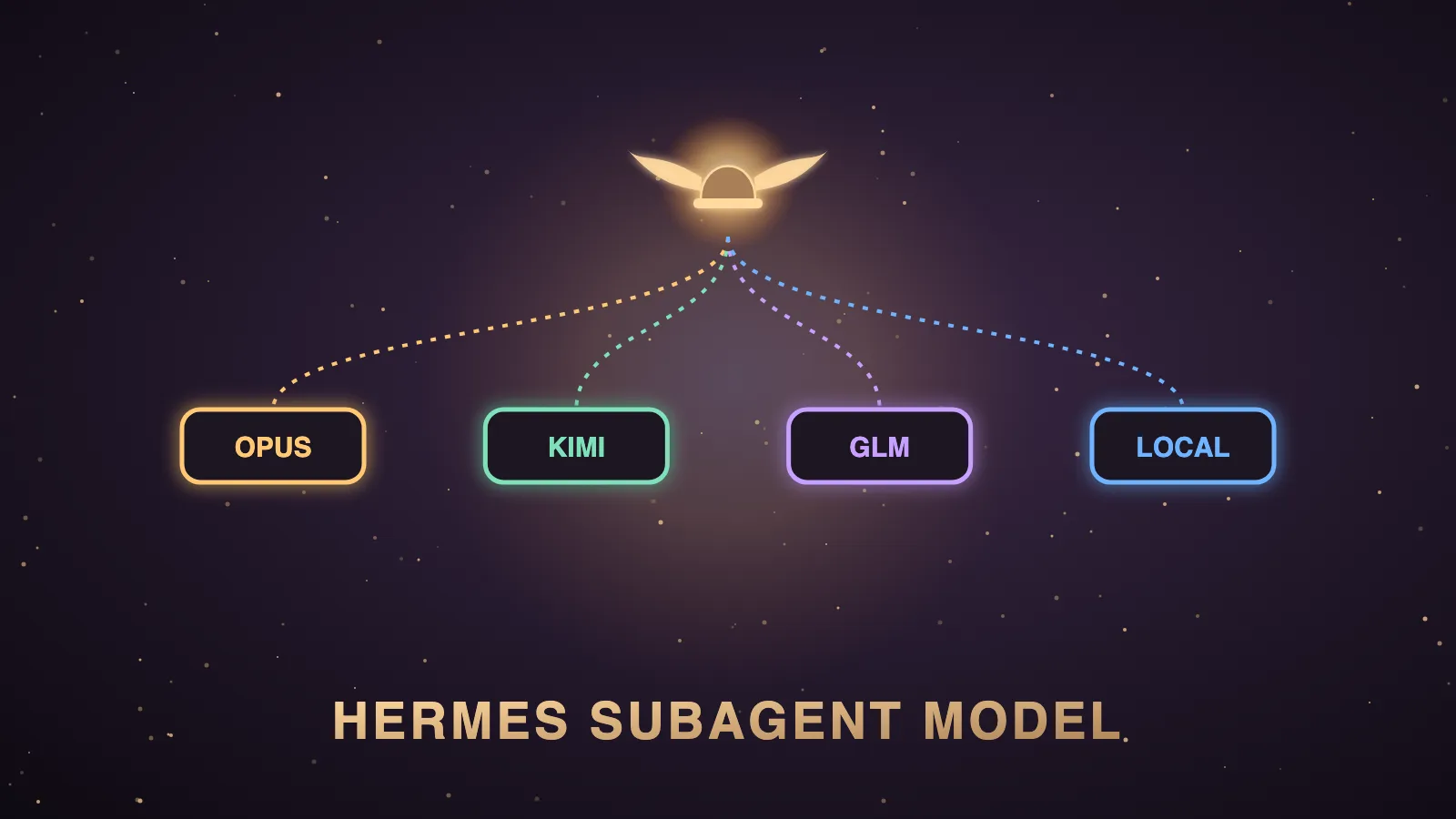
The Hermes subagent model is the AI model that Hermes Agent's child agents run on when the main agent hands work out with the delegate_task tool.
Hermes Agent is the free, open-source agent from Nous Research, and its subagents reuse the main agent's model unless you pin a different one with delegation.model.
The official delegation docs say a parallel batch of subagents typically burns the large majority of a run's total tokens.
That makes the worker model the setting that decides most of what your agent work costs.
I'm Julian Goldie, and in this post I'll explain what the subagent model is, how to set it and how it fails, and then I'll show you how the models you'd give your workers score on GoldieBench.
Everything about Hermes here comes from Nous's own documentation, not from a lab test of each setting.
The Hermes subagent model at a glance
This table sums up the setting before we go into detail.
| Question | Answer from the Hermes docs |
|---|---|
| What is it? | It is the model that delegate_task child agents run on. |
| What is the default? | Subagents use the parent's model, provider, API key and credential pool. |
| How do you pin one? | You set delegation.model, with optional delegation.provider or delegation.base_url. |
| Is there a menu for it? | Yes, hermes model → Configure auxiliary models → delegation, or Desktop's Settings → Model → Subagents. |
| Can each task get its own model? | Not with the default pin, but the advanced-delegation plugin and kanban's per-task override allow it. |
| What if a pinned model fails? | It only falls back if you declare delegation.fallback_providers. |
| Does Hermes ship its own model? | No, because the subagent model is whichever provider and model you connect. |
What is the Hermes subagent model?
When the main agent calls delegate_task, Hermes spawns child agents with isolated context, the parent's enabled tools and their own terminal sessions.
Each child gets a fresh conversation, and only its final summary returns to the parent.
The subagent model is the brain inside those children, and it is separate from the main model you pick with hermes model.
The docs say plainly that if you don't set a delegation model, subagents use the same model as the parent.
They also inherit the parent's credential pool, which means key rotation on rate limits still works for children.
For the mechanics of delegation itself, see my sibling post on Hermes Agent subagents.
The problem the subagent model setting solves
Most people put their main agent on the strongest model they can afford.
Then the agent delegates ten research jobs, and all ten workers run on that same expensive model.
The docs explain why that is wasteful.
Decomposing a problem into well-specified subtasks takes frontier-level judgment, while executing a subtask with a clear goal, full context and an output contract usually doesn't.
So the expensive thinking belongs with the planner, and the bulk work can often go to a cheaper model.
Nous calls this pattern frontier planner, inexpensive workers.
How to set the Hermes subagent model
The docs give the config version in exactly this form.
# ~/.hermes/config.yaml
model:
  default: "your-frontier-model"     # parent (planner) stays on the frontier model
delegation:
  model: "your-inexpensive-model"    # all delegate_task children run on this
  provider: "openrouter"             # optional: route children to a different provider
Setting only model keeps the parent's credentials and changes just the model name.
Adding provider resolves that provider's full credential bundle, including the base URL, key and API mode.
The precedence is delegation.base_url first, then delegation.provider, then the parent's provider.
If you'd rather use a menu, run hermes model and choose Configure auxiliary models, where the delegation entry reads "auto / inherit main agent" until you change it.
That picker ends with a reasoning-effort step stored as delegation.reasoning_effort.
In Hermes Desktop, open Settings → Model → Subagents, pick the profile under Applies to, choose a provider and model and click Apply.
The Desktop page also sets the subagent turn limit, concurrency, timeout and reasoning effort, and it never changes the main model or a running child.
Local subagent models through a direct endpoint
The docs also show subagents sent straight to an OpenAI-compatible endpoint, such as a local server.
delegation:
  model: "qwen2.5-coder"
  base_url: "http://localhost:1234/v1"
  api_key: "local-key"
A direct base_url takes precedence over delegation.provider.
Hermes auto-detects the Anthropic wire format for paths such as /anthropic, and delegation.api_mode overrides the guess.
If you leave out api_key, the configuration reference says Hermes falls back to OPENAI_API_KEY only.
What happens when a subagent model fails
The configuration reference says a child pinned by provider, endpoint or model uses a fallback chain only when you declare delegation.fallback_providers.
Without that list, a pinned child fails loudly instead of borrowing the parent agent's route.
An unpinned child still inherits the parent's fallback chain, and fallback_providers: [] disables child fallback.
The parent always hears about a failure, because the result carries status: "failed" and the error text.
In the CLI, the delegation tree prints a one-line reason, and gateway chats get the same notice even with tool progress switched off.
Choosing a different model per task
The docs are honest that the default pin is global.
With the default strategy, delegate_task has no per-task model parameter, so every child in a batch shares one model.
They list three ways round it.
- You can leave
delegation.modelunset for that session so the children use your strong main model. - You can install the official advanced-delegation plugin, which needs Hermes 0.22.5 or newer and adds model routes and profile routes.
- You can put quality-sensitive work on the kanban board, which has a per-task model override with
hermes kanban set-model.
Model routes are named options such as fast and deep, each with its own provider and model, and the agent picks one per task from the name and description alone.
Profile routes run a subagent as one of your Hermes profiles, with that profile's model, credentials, skills and SOUL.md.
Each routed result reports the provider, model, reasoning effort and speed tier the child actually ran on.
I've covered the plugin in full in Hermes advanced delegation.
A worked example: one research batch, two ways
Picture a main agent asked to compare five competitor pages and write a short report.
It splits the job into five subagent tasks, one per page, and keeps the report-writing for itself.
On the default setting, all five workers run on the same expensive model as the planner.
With a delegation.model pin, the five workers run on a cheaper model, and only the planning and the final report use the frontier model.
Each worker still needs a full brief, because the docs warn that subagents start with a completely fresh conversation and know nothing about the parent's chat.
A good brief names the URL, what to extract and the shape of the answer.
The delegation docs also let each task carry an output_schema, which makes the parent validate the worker's answer and send one correction turn if it doesn't match.
That safety net is a big reason a cheaper worker model can be trusted with structured jobs.
I won't put a percentage on the saving, because it depends on your tasks and your provider's pricing.
Common problems with the subagent model
If subagents still use the main model after a change, check that you edited the profile you're actually running.
If a child fails with a model-not-found error, the id doesn't exist on that provider, so pick it from the hermes model catalogue instead.
If a pinned worker stops when its provider is down, that is designed behaviour, and delegation.fallback_providers is the fix.
If a local endpoint gets the wrong wire format, set delegation.api_mode explicitly.
If the Desktop page shows a draft that never saved, remember that nothing applies until you click Apply.
Tips and limits
Subagents know nothing except the goal and context the parent writes, so a cheap worker with a vague brief will disappoint.
Each Hermes profile has its own config, so a pin in one profile doesn't touch the others.
The /review reviewer subagent runs on your main model unless you pin auxiliary.review.
delegation.max_iterations caps each child's tool-calling turns, and the docs give 250 as the default.
Hermes subagent model: how the worker models score on GoldieBench
Hermes doesn't ship its own subagent model, so the quality of every child depends on the model you connect.
GoldieBench is where I score models on real one-shot builds, and these are current averages from the live board.
| Model | GoldieBench average | What it suggests for a subagent role |
|---|---|---|
| Claude Opus 5 | 8.27 | It is the strongest single model on the board, so it suits the planner or a deep route. |
| Hermes MoA | 8.17 | It is a Hermes Mixture of Agents panel, which is a heavy choice for a worker. |
| GPT-5.6 Sol | 8.16 | It sits just behind Hermes MoA and also suits a planner role. |
| MiniMax M3 | 7.97 | It is a strong option a step below the top three. |
| Kimi K3 | 7.89 | It is a strong open option for build-heavy workers. |
| GLM-5.2 | 7.77 | It is another solid open-weight choice for workers. |
| Claude Opus 5.5 | 7.57 | It scores below Opus 5 on this board. |
| Qwable 5 27B Coder | 7.14 | It is a Qwen3.6-27B fine-tune that runs locally on MLX, which suits a private worker. |
| Gemini 3.6 Flash | 7.08 | It is the Flash model on the board and the closest match to a fast, inexpensive worker. |
| Claude Sonnet 5 | 7.01 | It is a mid-tier Anthropic option. |
| Gemma 4 12B · MLX | 3.98 | It shows how far a small local model falls behind on hard builds. |
The Hermes docs use google/gemini-3-flash-preview as their example worker model, and that exact model isn't on the board, so I won't guess its score.
Their example deep route is claude-opus-5, and Claude Opus 5 is on the board at 8.27.
GoldieBench measures one-shot builds, not summaries, so a lower-scoring model can still be a perfectly good research worker with a clear brief.
For build-heavy subagents, the gap between 8.27 and 7.08 is the kind of difference you'd notice on screen.
If you want private workers, my local models page shows what runs on your own hardware.
The wider shortlist is in my best Hermes Agent model explainer, and the release context is in my Hermes Agent v0.22 explainer.
Verdict
Inherit while you learn, then pin a cheaper delegation.model for routine workers and keep the planner on a top model from the board.
Add a fallback chain before anything important depends on a pinned worker, and use routes when one batch mixes light and heavy jobs.
Also On Our Network
- Agent Operatorsthe step-by-step Hermes subagent model setup
- AI Income Deskhow a business cuts agent costs with the subagent model
- AI Tool Verdictevery Hermes subagent model option, scored with a verdict
- agentos.guidethe Hermes subagent model quick start for an Agent OS
- agentos.guidethe best Hermes Agent model guide on agentos.guide
If you run an agency and want a clear plan for putting agents to work on client SEO, you can book a free strategy session with my team.
If you'd like a second opinion on which models your workers should run, you can also claim a free SEO strategy session and we'll look at it together.
Keep the planner strong, give the workers a cheaper brain and a clear brief, and you'll get the most out of the Hermes subagent model.
FAQ
What model do Hermes subagents use by default?
They use the same model as the parent agent, along with its provider, API key and credential pool, unless you set delegation.model.
How do I change the Hermes subagent model?
Set delegation.model, and optionally delegation.provider or delegation.base_url, in ~/.hermes/config.yaml. You can also use hermes model, Configure auxiliary models, delegation, or Settings, Model, Subagents in Desktop.
Does Hermes come with its own subagent model?
No. Hermes is the agent, and the subagent model is whichever provider and model you connect. On GoldieBench, Claude Opus 5 averages 8.27 and Gemini 3.6 Flash averages 7.08.
Can each Hermes subagent use a different model?
Not with the default strategy, because one pin covers every child. The advanced-delegation plugin's model routes or profile routes, or the kanban board's per-task override, allow it.
Do pinned subagents fall back to another provider?
Only if you declare delegation.fallback_providers. Without it, a pinned child fails loudly instead of borrowing the parent's route.
Which model is best for Hermes subagents?
For routine research a fast, inexpensive model with a clear brief is often enough, while build-heavy workers benefit from stronger models such as Kimi K3 at 7.89 or GLM-5.2 at 7.77 on GoldieBench.
Keep reading
 Hermes Herald AI Agent: Which Brain To Run It On, With Real GoldieBench Scores
 GEO Examples: Four Real AI Overview Wins, The Three Moves Behind Them, And The Models Writing The Answers
 Best Generative Engine Optimization Agency: Seven Picks By Region, And How The Models Behind AI Answers Score
🌐 Sister-site take: read this on agentos.guide