GoldieBench Blog · 8 min read
Hermes Advanced Delegation: What It Is, How To Set It Up, And Which Models To Route To
Hermes advanced delegation explained: model routes vs profile routes, install, config, failures, and which benchmarked models belong in each route.
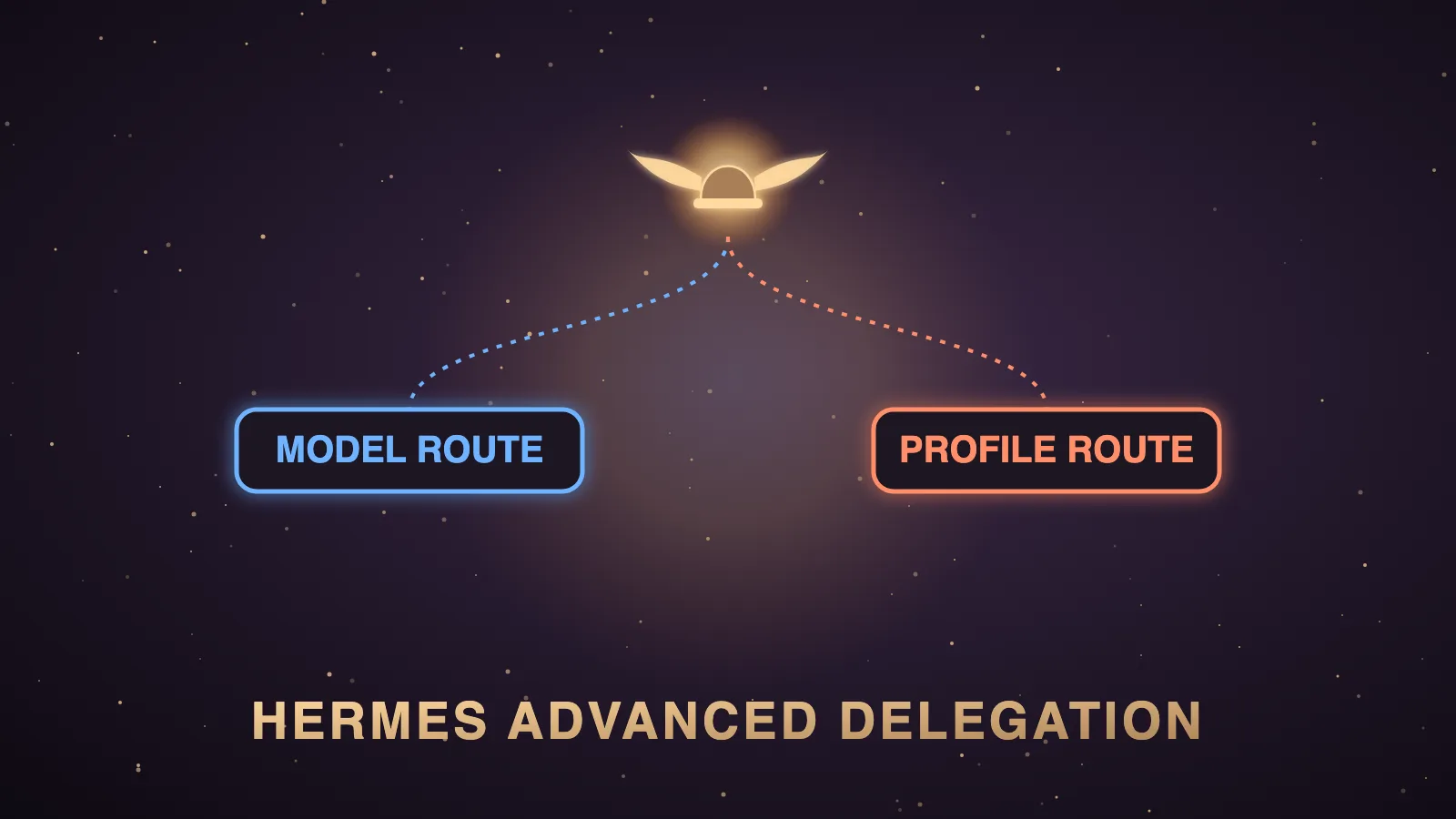
Hermes advanced delegation is an official Nous Research plugin that lets Hermes Agent route each subagent task to a named model or to one of your Hermes profiles.
It adds two modes to the delegate_task tool, called model routes and profile routes, next to the built-in default.
The official plugin page says it needs Hermes 0.22.5 or newer, the first release with pluggable delegation providers.
It is free, and it fixes the main limit of built-in delegation, where every subagent in a batch shares one model.
I'm Julian Goldie, and in this post I'll explain what the plugin does, how to set it up and how it fails, and then I'll show which benchmarked models belong in each route.
The Hermes facts here come from Nous's plugin page, docs and release notes, not from a lab test of every route.
Hermes advanced delegation at a glance
This table sums up the plugin before we go into detail.
| Question | Answer from Nous's pages |
|---|---|
| What is it? | It is an official plugin that adds per-task routing to delegate_task. |
| What are the modes? | Default, model routes (model_map) and profile routes (profile_routes), one at a time. |
| What version does it need? | It needs Hermes 0.22.5 or newer. |
| How do you install it? | You run hermes plugins install advanced-delegation in the profile that delegates. |
| How do you configure it? | You run hermes delegation config, or edit delegation.backends by hand. |
| Can the agent see keys? | No, because only route names and descriptions reach the model. |
| Does it ship a model? | No, because each route points at a provider and model you choose. |
What is Hermes advanced delegation?
Hermes Agent's main agent spawns subagents with delegate_task.
With the built-in default, every subagent runs on delegation.model and delegation.provider, or on the parent's model.
The delegation docs say that pin is global, because the default strategy has no per-task model parameter.
The plugin registers two delegation providers that change that.
Model routes give each task a choice of named model routes that you define.
Profile routes let each task run as one of your Hermes profiles, with that profile's own model, credentials, skills and SOUL.md.
Hermes core still runs the whole subagent lifecycle, including spawning, isolation, limits, background runs and results.
For the basics of subagents, see my sibling post on Hermes Agent subagents.
The problem the plugin solves
The delegation docs say a parallel batch of subagents typically burns the large majority of a run's tokens.
With one model per batch, a mix of easy and hard tasks either overpays on the easy ones or underpowers the hard one.
Model routes let the easy tasks pick a cheap route while the hard task picks a strong one.
Profile routes let specialist profiles, such as a coder and a researcher, each take the tasks that suit them.
The v0.22.5 release on GitHub, published on 23 October 2026, lists pluggable delegation backends that route subagents by model map or profile.
How to set up Hermes advanced delegation
First, update to Hermes 0.22.5 or newer, because the plugin page says 0.22.0 to 0.22.4 refuses to install or enable it.
Then install and configure it with the commands from the plugin page.
hermes plugins install advanced-delegation
hermes delegation config          # pick the mode, then edit its routes
hermes delegation config --show   # print the current mode and routes (no terminal needed)
Desktop users can click Install plugin under Settings → Model → Subagents instead.
Plugins install per profile, so install it in the profile that delegates, while target profiles only need to exist with a working model.
The model routes editor uses hermes model's own pickers and validates each route before saving it.
The profile routes editor is a checklist of your other profiles, an optional description each and a default.
Model routes, configured by hand
This is the full model routes example from the plugin page.
delegation:
  backend: model_map
  backends:
    model_map:
      options:
        - name: fast                     # what the agent picks
          description: "Cheap and quick: lookups, summaries, simple edits."
          provider: openrouter           # provider and/or base_url, plus model
          model: google/gemini-3-flash-preview
        - name: deep
          description: "Slow and careful: hard debugging and design work."
          provider: anthropic
          model: claude-opus-5
          reasoning_effort: high
          service_tier: fast             # optional speed tier: normal, fast or ultrafast
        - name: local
          description: "Private: runs on this machine."
          base_url: http://localhost:8080/v1
          model: qwen3-coder
      default: fast                      # optional: route for tasks that pick none
Each route needs name, description and model, plus provider or base_url.
Optional keys are reasoning_effort, service_tier, fallback_providers, api_key and api_mode.
A speed tier the route doesn't offer, or an unknown reasoning effort, refuses the spawn with a tool error.
The page recommends provider: over api_key:, because a key written here sits in config.yaml in plain text.
Profile routes and the security catch
Profile routes are a list under delegation.backends.profile_routes.profiles, with a name and description for each profile and an optional default.
That list is also an allowlist, so a profile you don't list can never be picked.
A profile route runs the subagent exactly as if you'd started hermes -p with that profile for the task.
The plugin page warns that a listed profile's credentials, credential pool, SOUL.md and terminal policy become usable by the delegating profile's subagents.
Only list profiles whose keys and terminal access you're happy to share.
Switching modes with /delegation
/delegation shows the current mode and a picker, with buttons on Telegram, Discord and Slack.
/delegation model_map saves model routes for the next session, and /delegation default switches back.
Changes apply from the next session, because the tool list is part of the prompt cache.
Adding --now rebuilds the current chat's tools at your next message, at the cost of one prompt-cache break.
How routed tasks behave and fail
Each task item gains one property, option for model routes or profile for profile routes, limited to your route names.
A task that picks nothing runs on the mode's default, or on the parent's model if there's no default.
While either route mode is active, delegation.model and delegation.provider aren't used.
If the backend is missing or disabled, delegate_task returns a tool error naming the fix, and no subagent starts.
A task that can't be routed is refused on its own with route.refused: true, while the rest of the batch runs.
A model route without its own fallback_providers uses delegation.fallback_providers, and a profile route uses that profile's chain.
Each result's route field shows the provider, model, reasoning effort and speed tier the child actually ran on.
Model routes vs profile routes
Both modes route work per task, but they suit different setups.
| Question | Model routes | Profile routes |
|---|---|---|
| What changes per task? | The provider and model change. | The whole profile changes, including model, credentials, skills and SOUL.md. |
| What do you need first? | You need a list of models in one profile. | You need separate Hermes profiles that already work. |
| Best for | It suits mixing cheap and strong models in one batch. | It suits handing tasks to specialist agents. |
| Fallback | It uses the route's own chain or delegation.fallback_providers. | It uses the target profile's own chain. |
| Main risk | A key written into a route is stored in plain text. | The target profile's credentials become usable. |
I'd start with model routes, because they need nothing beyond the profile you already use.
Profile routes become worth it once you've built specialist profiles, such as a coder with coding skills and a researcher with research skills.
Each mode keeps its own settings, so you can try one and switch back without losing the other.
Who Hermes advanced delegation is for
It suits anyone whose subagent batches mix quick lookups with hard reasoning or build work.
It suits agencies that want private client work on a local route while public research uses a cloud route.
It suits teams that already run several Hermes profiles and want the main agent to hand work between them.
It isn't needed if your agent rarely delegates, because a single delegation.model pin is simpler.
It also isn't a replacement for the kanban board when work must survive a restart, because kanban tasks are durable and subagents aren't.
Tips and limits
Route descriptions are the only thing the agent reads, so write them as clear instructions about when to pick each route.
Start with two model routes, such as fast and deep, before you add more.
Watch the first routed batch live, which my video at the top shows how to do, and check the route each task chose.
The plugin doesn't make subagents durable, so a Hermes restart still doesn't resume a running child.
My video on the Hermes 0.22 release, embedded below the post, covers the release line this plugin sits on.
Hermes advanced delegation: which models to route to
The plugin doesn't ship a model, so every route is only as good as the model you put behind it.
GoldieBench scores models on real one-shot builds, and these are current averages from the live board.
| Model | GoldieBench average | Route it fits |
|---|---|---|
| Claude Opus 5 | 8.27 | It fits a deep route, and it matches the plugin page's claude-opus-5 example. |
| Hermes MoA | 8.17 | It is a Hermes Mixture of Agents panel, which is heavy for a single route. |
| GPT-5.6 Sol | 8.16 | It is another strong deep-route option. |
| MiniMax M3 | 7.97 | It is a strong build route a step below the top. |
| Kimi K3 | 7.89 | It suits a build route for coding tasks. |
| GLM-5.2 | 7.77 | It is a solid open-weight build route. |
| Qwable 5 27B Coder | 7.14 | It runs locally on MLX, so it suits a local route. |
| Gemini 3.6 Flash | 7.08 | It is the Flash model on the board and the closest fit for a fast route. |
| Gemma 4 12B · MLX | 3.98 | It shows the risk of a small local model on hard build tasks. |
The plugin page's fast-route example, google/gemini-3-flash-preview, isn't on the board, so I won't guess its score.
Its local-route example, qwen3-coder, isn't on the board either.
GoldieBench measures one-shot builds, so a fast route doing summaries can use a lower-scoring model than a route that builds pages or tools.
A sensible starting pair is a fast route on a Flash-class model and a deep route on a top model such as Claude Opus 5 at 8.27.
For private work, my local models page shows what runs on your own hardware.
For the single-pin alternative, see my Hermes subagent model explainer, and for the wider shortlist see my best Hermes Agent model explainer.
Verdict
Hermes advanced delegation is the right upgrade once your subagent batches mix easy and hard work, and model routes are the place to start.
Put a top model from the live board behind your deep route, a fast model behind your fast route, and only list profiles you trust in profile routes.
Also On Our Network
- Agent Operatorsthe five-step Hermes advanced delegation install guide
- AI Income Deskfive ways a business uses Hermes advanced delegation
- AI Tool Verdictmodel routes versus profile routes, scored with a verdict
- agentos.guidewhether Hermes advanced delegation belongs in your Agent OS
- agentos.guidethe Hermes kanban guide on agentos.guide
If you run an agency and want a clear plan for putting agents to work on client SEO, you can book a free strategy session with my team.
If you'd like help choosing which models go behind your routes, you can also claim a free SEO strategy session and we'll look at it together.
Pick a strong deep route, a fast cheap route and trusted profiles, and you'll get the most out of Hermes advanced delegation.
FAQ
What is Hermes advanced delegation?
It is an official Nous Research plugin that adds model routes and profile routes to delegate_task, so each subagent task can run on a named model or as one of your Hermes profiles.
What version of Hermes does advanced delegation need?
It needs Hermes 0.22.5 or newer. The plugin page says Hermes 0.22.0 to 0.22.4 refuses to install or enable it.
Does Hermes advanced delegation include its own model?
No. Each route points at a provider and model you choose. On GoldieBench, Claude Opus 5 averages 8.27 and Gemini 3.6 Flash averages 7.08.
What is the difference between model routes and profile routes?
Model routes pick a provider and model per task, while profile routes run the subagent as a whole Hermes profile with its own model, credentials, skills and SOUL.md.
Can the agent see my API keys?
No. Only route names and descriptions reach the model, and the raw provider, model id, endpoint and key never become tool parameters.
Why doesn't my delegation mode change straight away?
Mode changes apply from the next session because the tool list is part of the prompt cache. /delegation with --now applies it to the current chat at the cost of one cache break.
Keep reading
 Hermes Herald AI Agent: Which Brain To Run It On, With Real GoldieBench Scores
 GEO Examples: Four Real AI Overview Wins, The Three Moves Behind Them, And The Models Writing The Answers
 Best Generative Engine Optimization Agency: Seven Picks By Region, And How The Models Behind AI Answers Score
🌐 Sister-site take: read this on agentos.guide