GoldieBench Blog · 6 min read
Hermes Delegation + Which AI Models To Put In The Planner And Worker Seats, With Real GoldieBench Scores
Which models to run as the planner and which as the delegate_task workers, using scores read on the live GoldieBench pages on 3 November 2026.
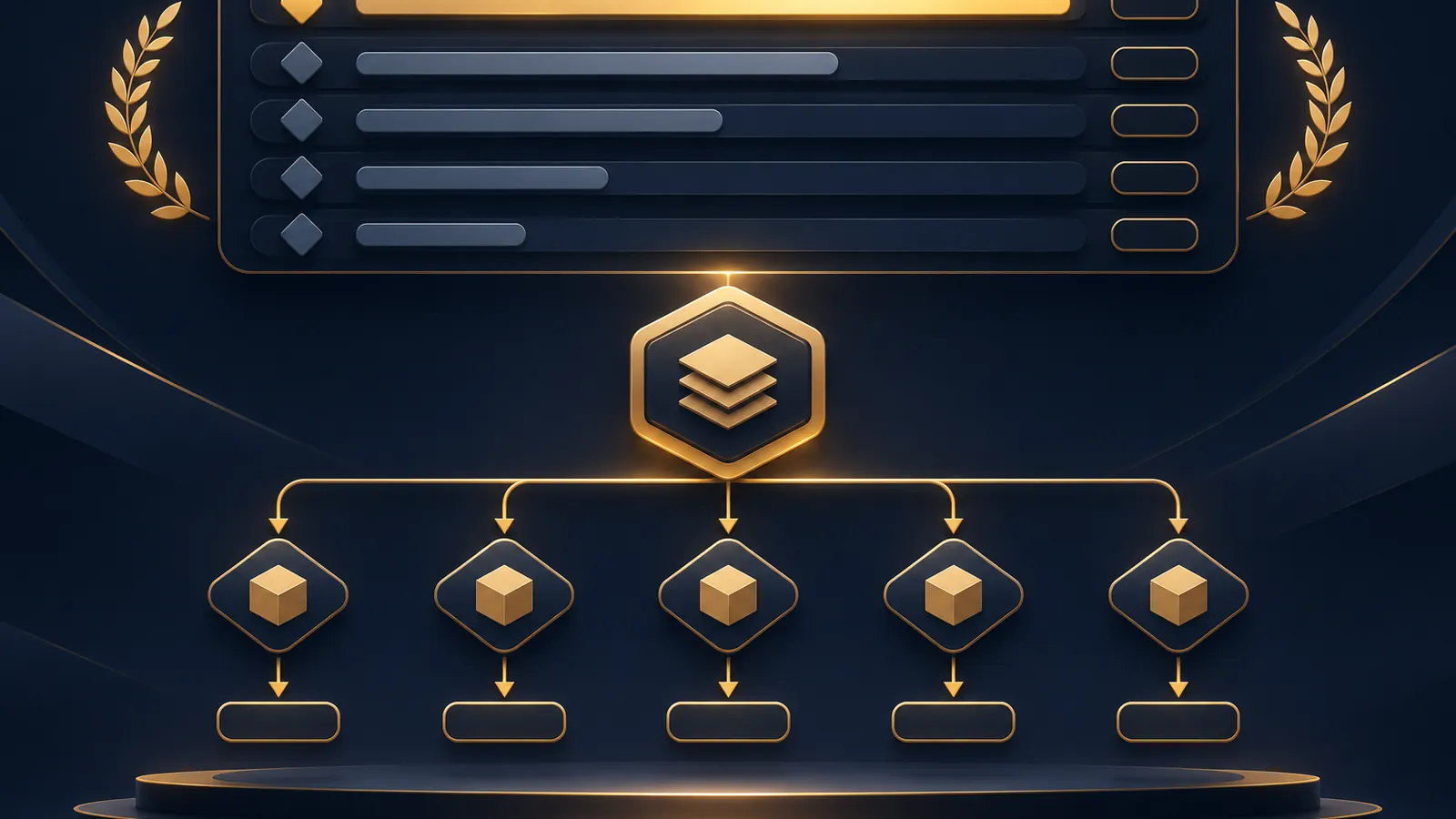
Hermes delegation splits every run into two model seats, a planner and its workers, and the GoldieBench scores help you fill each one.
The parent model breaks the job down; the delegate_task children do the volume.
Below are the scores I read on the live GoldieBench pages on 3 November 2026, what they do and don't tell you about subagents, and how to turn them into a model map.
If you'd rather my team picked the models for your workload, book a free SEO strategy session, or see how members set up routes inside the AI Profit Boardroom.
The Two Seats In Every Delegated Run
The Hermes delegation docs state the logic directly: decomposing a problem into well-specified subtasks takes frontier-level judgement, while executing one usually doesn't.
They also note that a parallel batch of subagents typically burns the large majority of a run's tokens.
So the planner seat rewards the highest score you can get, and the worker seat rewards a model that's good enough and quick.
By default every child inherits the parent's model, which puts your most expensive model in the seat that uses the most tokens.
One setting changes that: delegation.model, with an optional delegation.provider.
GoldieBench Scores For A Delegation Shortlist
| Model | Avg score | Tasks | Gold medals | Page read |
|---|---|---|---|---|
| Claude Opus 5 | 8.27/10 | 50 | 13 | Opus 5 |
| Hermes MoA | 8.17/10 | 47 | 3 | Hermes MoA |
| GPT-5.6 Sol | 8.16/10 | 50 | 2 | GPT-5.6 Sol |
| Kimi K3 | 7.89/10 | 50 | 8 | Kimi K3 |
| GLM-5.2 | 7.77/10 | 47 | 5 | models page |
| Gemini 3.6 Flash | 7.08/10 | 50 | 1 | Gemini 3.6 Flash |
| Claude Sonnet 5 | 7.01/10 | 47 | 0 | Sonnet 5 |
The GoldieBench models page compares 33 frontier models, and Fusion tops it at 8.59 across 47 tasks.
I've left Fusion off because it's an OpenRouter multi-model panel rather than a single model you'd pin as a worker.
What These Scores Mean For Subagents
The methodology page explains how the numbers are made: every model gets the same fixed prompts, one shot each, and the result is a single HTML file Julian scores 0 to 10.
That's a direct read on first-try build quality.
It isn't a test of tool calling across 100 turns, of following a schema, or of how a model behaves as one child in a batch.
So treat the scores as a quality floor for the work a child returns, not as a delegation benchmark.
The gap between rows is the useful part: Opus 5 and Gemini 3.6 Flash sit 1.19 points apart, which tells you what you give up when a task drops from the planner seat to the worker seat.
Planner Seat: Claude Opus 5 Or GPT-5.6 Sol
Claude Opus 5 averages 8.27 across 50 tasks, with 13 gold medals on its page.
GPT-5.6 Sol averages 8.16 across 50 tasks; its page notes it was benched at medium reasoning effort through OpenRouter.
Either belongs where judgement matters most: writing the goals, the context and the output contracts every child depends on.
A child knows nothing beyond what the planner writes, so a stronger planner means better briefs for every worker.
Set the planner as your main model and leave it there:
model:
  default: "your-frontier-model"
delegation:
  model: "your-inexpensive-model"
provider: "openrouter"Worker Seat: Gemini 3.6 Flash For Volume
Gemini 3.6 Flash averages 7.08 across 50 tasks, and its page tagline is "faster, cheaper, fewer tokens".
For lookups, summaries and simple edits, that profile suits a worker that runs ten times in one batch.
It's also close to what the docs themselves use: their fast route example points at a Gemini Flash preview model on OpenRouter.
If a worker's output is going straight into a schema, add an output_schema to the task; Hermes validates it and allows one correction turn.
Long Unattended Children: Kimi K3
Kimi K3 averages 7.89 across 50 tasks with 8 gold medals.
Its GoldieBench page says it's wired into the Agent OS as the kimi-k3 Hermes profile and used for long unattended agent runs.
That makes it a natural target for profile_routes, where a child runs as one of your profiles with that profile's own model and credentials.
Remember the docs' warning on that mode: listing a profile shares its keys, SOUL.md and terminal policy with this profile's subagents.
Coding Children: Where Sonnet 5 Fits
Claude Sonnet 5 averages 7.01 across 47 tasks on the one-shot bench.
Its page also lists an 82.1% SWE-bench Verified reference figure, flagged as an external benchmark, not a GoldieBench score.
The page's own advice is to reach for it on iterative, tool-using software engineering, and notes GLM 5.2 beat it 4-1 on one-shot visual builds there.
That makes it a candidate for a coder route paired with delegation.worktree_isolation: true, which gives each coding child its own git branch.
Hermes MoA: A Panel, Not A Worker
Hermes MoA scores 8.17 across 47 tasks, right behind Opus 5.
Its page describes it as one prompt sent to a panel of frontier models, then merged by an aggregator; the default panel is Opus 4.8 plus GPT-5.5.
Every MoA answer is several model calls, so it's a poor fit for a ten-child fan-out.
Keep it for the single hard question where you want the panel's best draft.
Turn The Scores Into A model_map
The official advanced-delegation plugin lets the planner pick a model per task; its README says it needs Hermes 0.22.5 or newer.
Install it with hermes plugins install advanced-delegation, then define your routes.
Here is the docs' own shape, with names that match the two seats:
delegation:
  backend: model_map
  backends:
    model_map:
      options:
        - name: fast
          description: Cheap and quick; lookups, summaries, simple edits.
          provider: openrouter
          model: google/gemini-3-flash-preview
        - name: deep
          description: Slow and careful; hard debugging and design work.
          provider: anthropic
          model: claude-opus-5
          reasoning_effort: high
      default: fast
Swap in the model IDs your provider lists for the models you picked from the table.
The planner sees only fast and deep with their descriptions, never the provider or model fields, so write descriptions that say when each route is worth it.
I compare route choices in more depth on the Hermes advanced delegation page.
Check The route Field, Not The Config
Each routed result reports a route object listing the provider and model that actually answered, along with its effort level and tier.
If fallback_activated: true appears, a fallback provider stepped in, and the benchmark score you chose for no longer applies to that answer.
Unroutable tasks fail alone with route.refused: true; Hermes never quietly runs them on a different route.
v0.22.6: Changing The Map Without Breaking A Chat
The v0.22.6 release on 2 November 2026 lists "/delegation choices saved for the next session".
/delegation default now saves delegation.backend to config.yaml and applies from /new, because the route names live in the cached tool list.
/delegation model_map --now rebuilds the current chat's tools at its next turn, at one prompt-cache miss.
So when you re-rank your workers after a new GoldieBench result, save the change and start a fresh session.
Want the trainings and the Agent OS that runs these routes? Join the AI Profit Boardroom.
Also On Our Network
- Agent Operatorsthe seven-step operator setup for delegate_task, worker models and saved backends
- AI Income Deskthe business case for subagents, with three use cases and the credential risk
- AI Tool Verdicta nine-criterion scorecard for subagents, including where the docs disagree
- agentos.guidefive copy-paste prompts that set up subagents inside your Agent OS
- aiprofitboardroom.comthe complete Hermes delegation guide on the AI Profit Boardroom blog
Pin a top scorer as your planner, put a fast model in the worker seat, and if you want my team to tune the split, book a free strategy session and bring your Hermes delegation routes.
FAQ
Which model should be the planner in Hermes delegation?
Pick a top scorer. On GoldieBench, Claude Opus 5 averages 8.27 and GPT-5.6 Sol 8.16, both across 50 tasks, read on 3 November 2026.
Do GoldieBench scores measure subagent performance?
No. They score one-shot builds of fixed prompts, each a single HTML file rated 0 to 10. Use them as a quality guide, not a delegation benchmark.
How do I give subagents a different model?
Set delegation.model and optionally delegation.provider in config.yaml. With the advanced-delegation plugin you can define named routes the planner picks per task.
How do I know which model a child actually used?
Read the route field on its result. It lists the provider, model, reasoning effort and speed tier, and fallback_activated shows when a fallback took over.
Keep reading
 Hermes Group Chat + Which AI Models To Seat In The Room, With Real GoldieBench Scores For Opus 5, GPT-5.6 Sol, Kimi K3 And Gemini 3.6 Flash
 Hermes Compaction + Which AI Models To Run As Main And Summary Model, With Real GoldieBench Scores For Opus 5, Kimi K3, MiniMax M3 And Gemini 3.6 Flash
 Hermes Agent Hooks + Which AI Models To Pair With Them, With Real GoldieBench Scores For Opus 5, Hermes MoA, Kimi K3 And Gemini 3.6 Flash
🌐 Sister-site take: read this on agentos.guide