GoldieBench Blog · 6 min read
Hermes Group Chat + Which AI Models To Seat In The Room, With Real GoldieBench Scores For Opus 5, GPT-5.6 Sol, Kimi K3 And Gemini 3.6 Flash
Each bot in a room can run its own model. Here are the scores that decide the lead, the reviewer, the long-run worker and the fast checker.
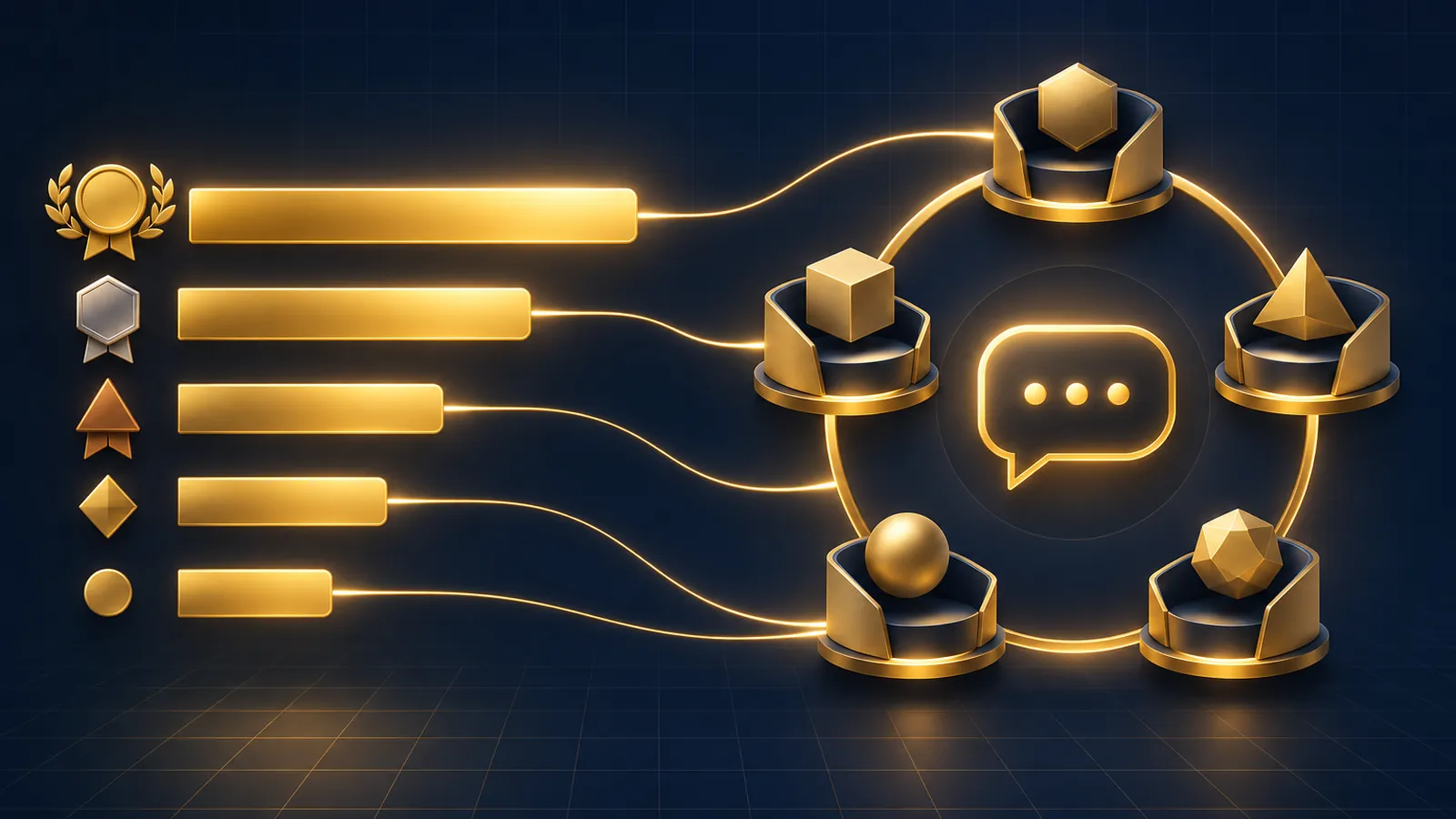
A Hermes group chat lets every bot in the room run a different model, which makes model choice a seating plan rather than a single pick.
Each bot is a Hermes profile with its own model and provider pin, and a room seats two to six of them in one conversation.
Below are the GoldieBench scores I read on the live pages on 3 November 2026, what they mean for each seat, and why the room's own limits change how much a big context window helps.
Want my team to match models to the seats in your setup? Book a free SEO strategy session.
Why A Room Is A Model-Mixing Tool
The Bot Mode docs say any provider and model pair Hermes knows can be pinned to a bot, and different bots can run on different models side by side.
In a room, those bots read the same thread and reply in up to three serial rounds per message.
So the room is where a strong lead model and a cheaper checker actually meet.
Mentions decide who speaks: name two bots and only those two take the round; name nobody and every member gets a turn, free to reply or pass.
The room settles once a full round passes in silence, so the discussion ends on its own once nobody has anything new.
The question this page answers: which model goes in which chair?
The Scores For A Room Shortlist
| Model | GoldieBench avg | Tasks | Page read |
|---|---|---|---|
| Fusion (OpenRouter) | 8.59 | 47 | /models/fusion |
| Claude Opus 5 | 8.27 | 50 | /models/opus5 |
| Hermes MoA | 8.17 | 47 | /models/moa |
| GPT-5.6 Sol | 8.16 | 50 | /models/ |
| Grok | 8.09 | 47 | /models/ |
| Kimi K3 | 7.89 | 50 | /models/kimik3 |
| Gemini 3.6 Flash | 7.08 | 50 | /models/gemini36 |
Every score is an average of 0–10 marks on the same fixed prompt set, one shot each, with a single HTML file out.
That measures first-try build quality, not how well a model argues in a room, so treat it as a signal for each seat's raw output.
Seat 1: The Lead — Claude Opus 5
Claude Opus 5 averages 8.27 across 50 tasks, with 13 golds, on its GoldieBench model page.
The same page lists a 1,000,000-token context window.
In a room I'd give it the lead seat: the bot you mention first in a brief, the one that drafts the answer others check.
Its page also flags a trade-off worth planning around: reasoning-by-default eats token budgets unless tuned.
In a room that cost repeats every round it speaks, so mention it deliberately rather than leaving every round open.
Seat 2: The Second Opinion — GPT-5.6 Sol Or Grok
A room is only useful if members can disagree, and that is likelier when they come from different vendors.
GPT-5.6 Sol averages 8.16 over 50 tasks and Grok averages 8.09 over 47, both on the GoldieBench models page.
Both sit within about two tenths of a point of Opus 5, so a reviewer seat on either one isn't a big drop in raw quality.
Give that bot a SOUL.md that tells it to challenge the lead and pass when it agrees.
The docs say each bot replies only when it has something new, so a well-briefed reviewer stays quiet on good drafts.
Seat 3: The Long-Run Worker — Kimi K3
Kimi K3 averages 7.89 across 50 tasks with 8 golds, per its model page.
The page tags it as tuned for long-horizon agent work, with a 1,048,576-token context.
That makes it the seat for slow, unattended jobs: a member that is visibly still working keeps its turn for up to three hours, according to the Bot Mode docs.
Point it at the heavy lifting and let the lead summarise what it returns.
Seat 4: The Fast Checker — Gemini 3.6 Flash
Gemini 3.6 Flash scores 7.08 across 50 tasks on its model page, which pitches it as faster, cheaper and lighter on tokens.
That is the lowest score on this shortlist, so I wouldn't give it the lead.
It fits a narrow job well: format checks, a fact list, a yes or no on whether the brief was met.
Scope it with mentions, such as @checker confirm all five points are covered, so it only speaks when called.
Why A 1M Context Matters Less Inside The Room
Here is the detail most model comparisons miss.
The Bot Mode docs cap what a member sees per turn: the room history since it last spoke, to a limit of roughly 200 messages or 32,000 characters.
Whichever of those two limits fills first wins, and the prompt then states how many older messages were dropped.
A single oversized message is cut to an 8,000-character excerpt.
So a million-token window doesn't give a bot more of the room; it helps in that bot's own chat, where you can load long material and post a summary back.
Choose room models on reply quality and speed first, and on context only for the bot that does solo deep work.
Room Versus Hermes MoA And Fusion
GoldieBench lists two panel systems near the top.
Hermes MoA averages 8.17 over 47 tasks; its page describes one prompt sent to a panel of models in parallel, then an aggregator writing one final answer, by default Opus 4.8 and GPT-5.5 aggregated by Opus 4.8.
Fusion tops the list at 8.59 over 47 tasks, as OpenRouter's multi-model ensemble.
A group chat is a different design: members reply in visible rounds, tag each other, and escalate to you, and no aggregator merges them.
Use MoA or Fusion when you want one merged answer; use a room when you want to see who said what and step in.
Keep The Room Bounded Whatever You Seat
Stronger models don't need longer rooms.
The docs cap each send at 10 messages and 3 rounds, and the configuration reference exposes hosted_rooms.discussion.max_rounds and max_messages for native server-hosted rooms, defaulting to 3 and 10.
If a member starts returning empty replies, press Compress history for it in Group settings; that runs /compress on its hidden room session.
Scheduled jobs can post into a member's room session too; the Hermes agent cron job guide covers the scheduling side.
What v0.22.6 Changes For Your Seating Plan
The v0.22.6 release of 2 Nov 2026 lists Desktop group chat rename, disband, mentions and attachment paste.
Mentions are the lever that matters most for model mixing, because a mention scopes the round to the bots you name and leaves expensive seats silent.
The CLI updates with hermes update; Desktop builds from the installer update with the next bundled release, as the release notes and the Desktop docs on updating explain.
For trainings on wiring each model into its own bot, the AI Profit Boardroom walks through it, and members can bring their seating plan to the weekly coaching calls.
Also On Our Network
- Agent Operatorsthe seven-step operator setup for a multi-bot room, mentions and fixes
- AI Income Deskwhether a room of AI bots pays off for a shop, firm or agency
- AI Tool Verdicta nine-point scorecard rating multi-bot rooms on control, context and durability
- agentos.guidefive copy-paste prompts that run a council of bots in your Agent OS
- aiprofitboardroom.comthe complete Hermes group chat guide on the AI Profit Boardroom blog
Seat Opus 5 as the lead and a different-vendor reviewer beside it today, and book a free strategy session if you want your Hermes group chat models checked.
FAQ
Can each bot in a Hermes group chat use a different model?
Yes. Each bot has its own model and provider pin, and the Bot Mode docs say different bots can run different models side by side.
Which model scores highest on this shortlist?
Fusion at 8.59 over 47 tasks, then Claude Opus 5 at 8.27 over 50 tasks, on the GoldieBench models page read on 3 November 2026.
Is a group chat the same as Hermes MoA?
No. MoA sends one prompt to a panel and an aggregator writes one answer. A group chat shows each bot replying in rounds, with mentions and escalation to you.
Does a bigger context window help inside the room?
Only a little. Each turn carries about 200 messages or 32,000 characters of room history, so large windows matter more in a bot’s own chat.
Do GoldieBench scores measure group deliberation?
No. They average 0 to 10 marks on one-shot build tasks, so use them to judge each seat’s raw output quality.
Keep reading
 Hermes Delegation + Which AI Models To Put In The Planner And Worker Seats, With Real GoldieBench Scores
 Hermes Webapp + Which AI Models To Run In Your Browser Sessions, With Real GoldieBench Scores For Opus 5, GPT-5.6 Sol, Kimi K3 And Grok
 Hermes Agent Cron Job + Which AI Models To Pin On Each Schedule, With Real GoldieBench Scores For Opus 5, GPT-5.6 Sol, Kimi K3 And Gemini 3.6 Flash
🌐 Sister-site take: read this on agentos.guide