GoldieBench Blog · 8 min read
Generative Engine Optimization vs SEO: How They Differ, Why They Depend On Each Other, And The Models Behind The Answers
Generative engine optimization vs SEO explained: how they differ, why GEO depends on SEO, clicks vs mentions, and how the AI models behind answers score.
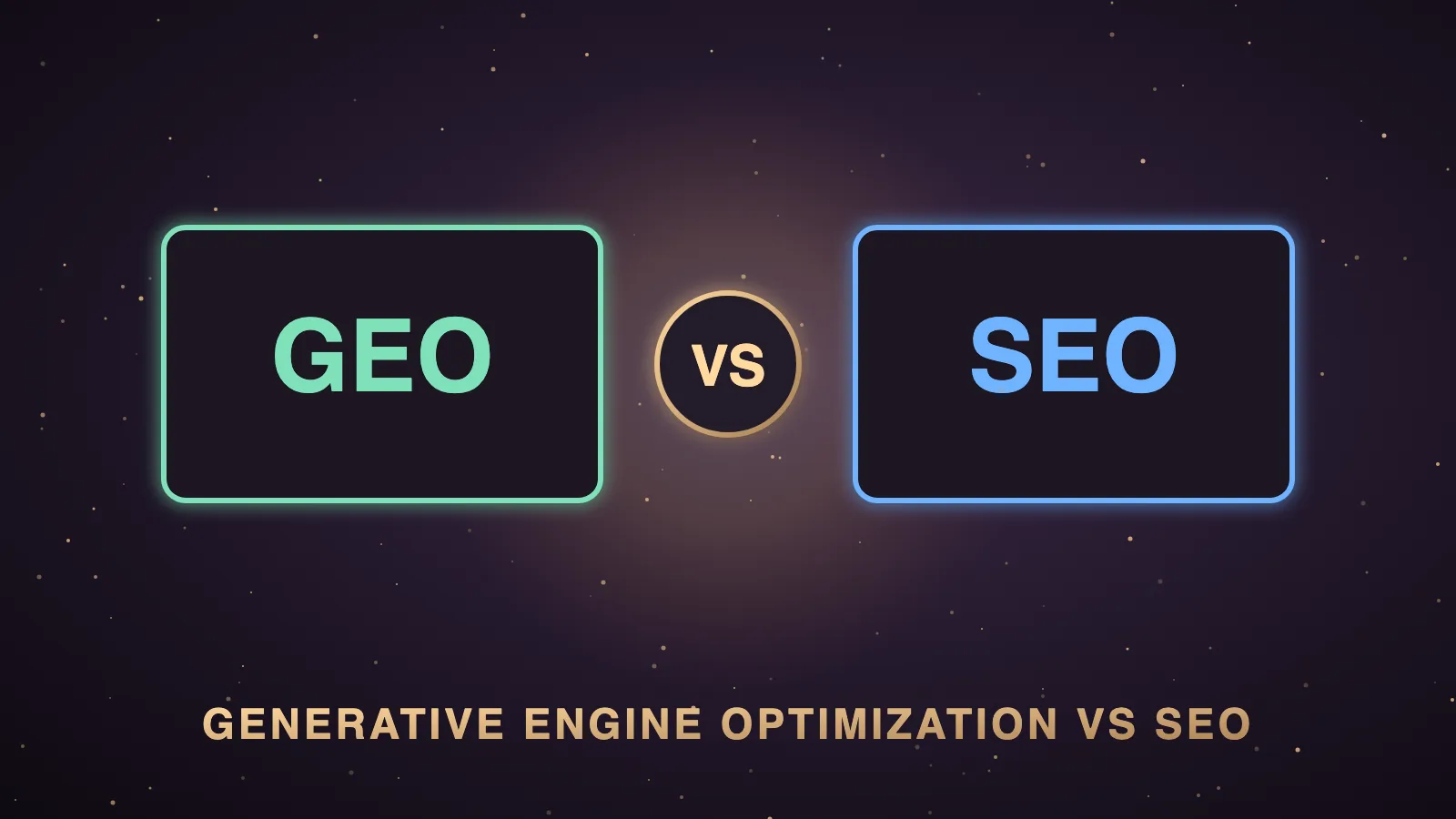
Generative engine optimization vs SEO isn't really a choice, because GEO is built on top of SEO and can't work without it.
SEO gets your pages ranked in the search results, and GEO gets your business named inside the AI answer that's written from those pages.
So my answer is to do both, with SEO as the base and GEO as the layer that turns rankings into recommendations.
If you want my team to look at your own site, book a free one-to-one GEO, AEO AI audit and get a custom game plan.
Below you'll get the comparison table, a plain explanation of each, the metrics and the effort split.
Near the end, I'll show how the AI models behind today's answers score on this leaderboard, and why that's a separate question.
Generative engine optimization vs SEO at a glance
This table answers the question in one screen.
| Factor | SEO | GEO |
|---|---|---|
| Full name | Search engine optimisation. | Generative engine optimisation. |
| What you're trying to win | A ranking in the search results. | A mention or citation inside an AI answer. |
| Where it shows | The results list on Google or Bing. | Google AI Overviews, AI Mode, ChatGPT, Gemini, Perplexity and Claude. |
| How many get seen | A full page, so position seven still gets some clicks. | Maybe one to three names, so there's no room for number seven. |
| How you measure it | Clicks, impressions and position in Search Console. | Who the AI names, which pages it cites and how it describes you. |
| Works on its own? | Yes. | No, it leans on the pages that already rank. |
The last row is the reason I never treat them as rivals.
What is SEO?
SEO stands for search engine optimisation.
It's the work of getting your pages crawled, indexed and ranked by a search engine, and then clicked.
The basics are technical health, useful pages that match what people search for, and links from other sites.
I've done SEO for over a decade, and those basics still decide whether a page gets seen at all.
What is GEO?
GEO stands for generative engine optimisation.
The term comes from a 2023 research paper called GEO: Generative Engine Optimization, by a team from Princeton University, IIT Delhi and two independent researchers.
The paper was accepted to the KDD 2024 conference.
It describes generative engines as search tools that gather information from several sources and summarise it with a large language model.
In plain words, GEO is the work of becoming the name in the answer when someone asks Google AI, Gemini or ChatGPT a question.
How GEO and SEO depend on each other
The AI reads the pages that rank and sums up what they say.
I compare it to five friends recommending the same restaurant.
If five good pages in the top ten say the same name, the AI repeats that name.
Google's AI features and your website page says a page has to be indexed and eligible to show with a snippet before it can be a supporting link in AI Overviews or AI Mode.
It also says there are no additional requirements, no special schema and no AI text files needed.
So SEO decides which pages the AI reads, and GEO decides what those pages say about you.
How GEO and SEO differ
They differ in what counts as a win.
Old SEO gave people ten blue links, and ranking seventh still brought some clicks.
AI answers usually give a short list of one to three names, so you're either named or skipped.
They also differ in what the content needs.
The GEO paper found that adding citations, quotations and statistics improved visibility in AI answers by roughly 30 to 40 percent on its main measure.
It also found that keyword stuffing, an old SEO trick, performed poorly.
The metrics compared
SEO has a ready-made dashboard, while GEO needs a log you build yourself.
| Metric | SEO or GEO | Where you get it |
|---|---|---|
| Clicks and impressions | SEO | The Google Search Console performance report. |
| Average position | SEO | The Google Search Console performance report. |
| Named in the AI answer | GEO | A weekly log of the same buyer questions. |
| Cited as a source | GEO | The links shown beside the AI answer. |
| Accuracy of the description | GEO | The same weekly log. |
Google says AI Overviews and AI Mode traffic is counted inside the normal Search Console totals under the "Web" search type.
In my latest video I point out that Google and the AI engines don't report AI traffic well yet, so the log fills the gap.
📞 Want to see where you rank but aren't named?
Book a free AEO SEO strategy session and my team will look at your site, your competitors and the keywords you're closest to winning.
How to split your effort
The split depends on where your site is today, and this is my rule of thumb rather than a formula.
| Your site today | Where most effort goes | Why |
|---|---|---|
| Most key pages aren't indexed yet | SEO | The AI can't cite a page Google hasn't indexed. |
| Some pages rank, but AI answers name competitors | Both, evenly | Your ranking pages are being read, so GEO can change what they say. |
| You rank well but you're missing from AI answers | GEO | The gap is agreement and proof, not rankings. |
What my own screens show
In my GEO video, the AI Overview for "best HARO agency" lists five suppliers and links Goldie Agency first.
Goldie Agency also ranks first organically for that search, so both layers came from the same pages.
Google's AI Overview for "best geo expert" names me first and cites several of my pages.
For "best AI SEO community", my AI Profit Boardroom ranks first, in an article that was three days old when I checked.
One of my sites went from zero to about 1,300 Google clicks a day, and on one day it got over 9,600 impressions inside Google's AI features.
These are my own results, one of my sites flopped, and nobody can guarantee what an AI answer will say.
The GEO habits I add on top of SEO
I call my GEO system the answer engine, and it has three moves.
Be the source means every page has a real case study, because the AI can't write about a test only you ran.
Be everywhere means several sites and platforms point to the same answer from different angles.
Be first means publishing within 24 hours of a topic appearing, like "Jev architecture" and "Jev waitlist" the weekend Jev AI dropped.
The free workflow I use for both
In my latest video I export Google Search Console data to a CSV and give it to Hermes Agent, which is free and open source.
I ask it to analyse what's actually working and suggest keyword and topic ideas to rank inside AI search engines.
It builds a report with clicks, brand share of clicks, non-brand click-through rate and a verdict on my best pages.
Then I give it my SEO skill, a roughly 100-point checklist that writes from a case-study angle, and let it publish to my sites.
Google's page on using generative AI content, updated on 1 October 2026, says it's "critical" to fact-check AI content by hand, so every page gets a human review.
If you'd like help setting that up, book a free strategy session and my team will map it to your site.
Common mistakes when people compare GEO and SEO
The biggest mistake is dropping SEO because AI answers look like they replaced it, which removes your pages from the set the AI reads.
The second is paying for "AI text files" or special markup, even though Google says its AI features don't need them.
The third is stuffing keywords into pages, which the GEO paper found performed poorly in AI answers.
The fourth is publishing AI drafts without a human fact-check, which goes against Google's 1 October 2026 guidance.
The last is expecting a guarantee, because nobody controls what an AI answer will say.
If you avoid those five, you're already ahead of most sites trying to win both layers.
Two ways to get help
The first is the free AEO SEO strategy session, which I call a free one-to-one GEO, AEO AI audit, and it's a call rather than a written report.
The second is the AI Profit Boardroom, with my Agent OS, a search OS that finds GEO keywords from your own Search Console data, my SEO skill, four coaching calls a week and 3,400+ members.
📞 Ready to run both layers properly?
Claim a free strategy session and leave with a plan to rank in Google and AI search.
The models behind the AI answers, on GoldieBench
GEO and SEO aren't AI models, so neither has a GoldieBench score of its own.
The AI answers you're trying to appear in are written by products from model makers like Google, OpenAI and Anthropic.
Here's how models from those makers score on their live GoldieBench pages today.
| Model | Maker | The maker's assistant | GoldieBench average |
|---|---|---|---|
| Claude Opus 5 | Anthropic | Claude | 8.27 |
| GPT-5.6 Sol | OpenAI | ChatGPT | 8.16 |
| Claude Opus 5.5 | Anthropic | Claude | 7.57 |
| Grok 4.7 | xAI | Grok | 7.15 |
| Gemini 3.6 Flash | Gemini | 7.08 |
Claude Opus 5 leads this group at 8.27, with GPT-5.6 Sol close behind at 8.16.
Gemini 3.6 Flash is the only Google model on the board, at 7.08.
Google says AI Overviews and AI Mode may use different models and techniques, so the board can't tell you which exact model writes a given answer.
Why model scores don't settle GEO vs SEO
GoldieBench scores one-shot builds, which is a very different job from picking which business to name.
A stronger model doesn't automatically mention your business more, because the answer depends on the pages it can find.
That's why SEO still matters so much, because it decides which pages are in front of the model in the first place.
Where model quality does matter is your own workflow, such as analysing Search Console data or drafting pages from your case studies.
For that job I'd pick a model that follows detailed instructions well, and I'd still fact-check every line it writes.
Related reading on GoldieBench
My GEO vs traditional SEO post covers what changed from the ten-blue-links era.
My GEO vs AIO post clears up what people mean by AIO.
My GEO examples post walks through four real AI answers from my own screens.
Also On Our Network
- Agent Operatorsthe operator setup for running GEO and SEO together
- AI Income Deskthree budget splits between GEO and SEO
- AI Tool VerdictGEO and SEO judged round by round
- agentos.guiderunning GEO and SEO as one Agent OS loop
- agentos.guidemy GEO examples guide on agentos.guide
Build the SEO base, add the GEO layer on top and measure both, and you'll have your own answer to generative engine optimization vs SEO.
FAQ
What is the difference between generative engine optimization vs SEO?
SEO ranks your pages in the search results, while GEO gets your business named or cited inside an AI answer. GEO depends on SEO because AI answers lean on the pages that already rank.
Does GEO replace SEO?
No. Google says a page must be indexed and eligible to show with a snippet before it can appear in AI Overviews or AI Mode, so SEO is still required.
How do I measure GEO compared with SEO?
SEO is measured with clicks, impressions and position in Search Console. GEO is measured with a weekly log of who the AI names, which pages it cites and how accurately it describes you.
Does GEO or SEO have its own AI model?
No. Both are ways of publishing and improving content, and the AI answers come from products built by companies like Google, OpenAI and Anthropic.
How do the models behind AI answers score on GoldieBench?
Claude Opus 5 averages 8.27, GPT-5.6 Sol 8.16, Claude Opus 5.5 7.57, Grok 4.7 7.15 and Gemini 3.6 Flash 7.08. GoldieBench measures one-shot builds, not which businesses a model names.
Is the free strategy session a written report?
No. It is a one-to-one call where my team looks at your site, your competitors and the keywords you're closest to winning, then gives you a custom game plan.
Keep reading
 Hermes Herald AI Agent: Which Brain To Run It On, With Real GoldieBench Scores
 GEO Examples: Four Real AI Overview Wins, The Three Moves Behind Them, And The Models Writing The Answers
 Best Generative Engine Optimization Agency: Seven Picks By Region, And How The Models Behind AI Answers Score
🌐 Sister-site take: read this on agentos.guide