GoldieBench Blog · 8 min read
Generative Engine Optimization vs Traditional SEO: What Changed, What Still Works, And The Models Writing The New Answers
Generative engine optimization vs traditional SEO explained: ten blue links vs a short AI list, what still works, what changed and the models behind it.
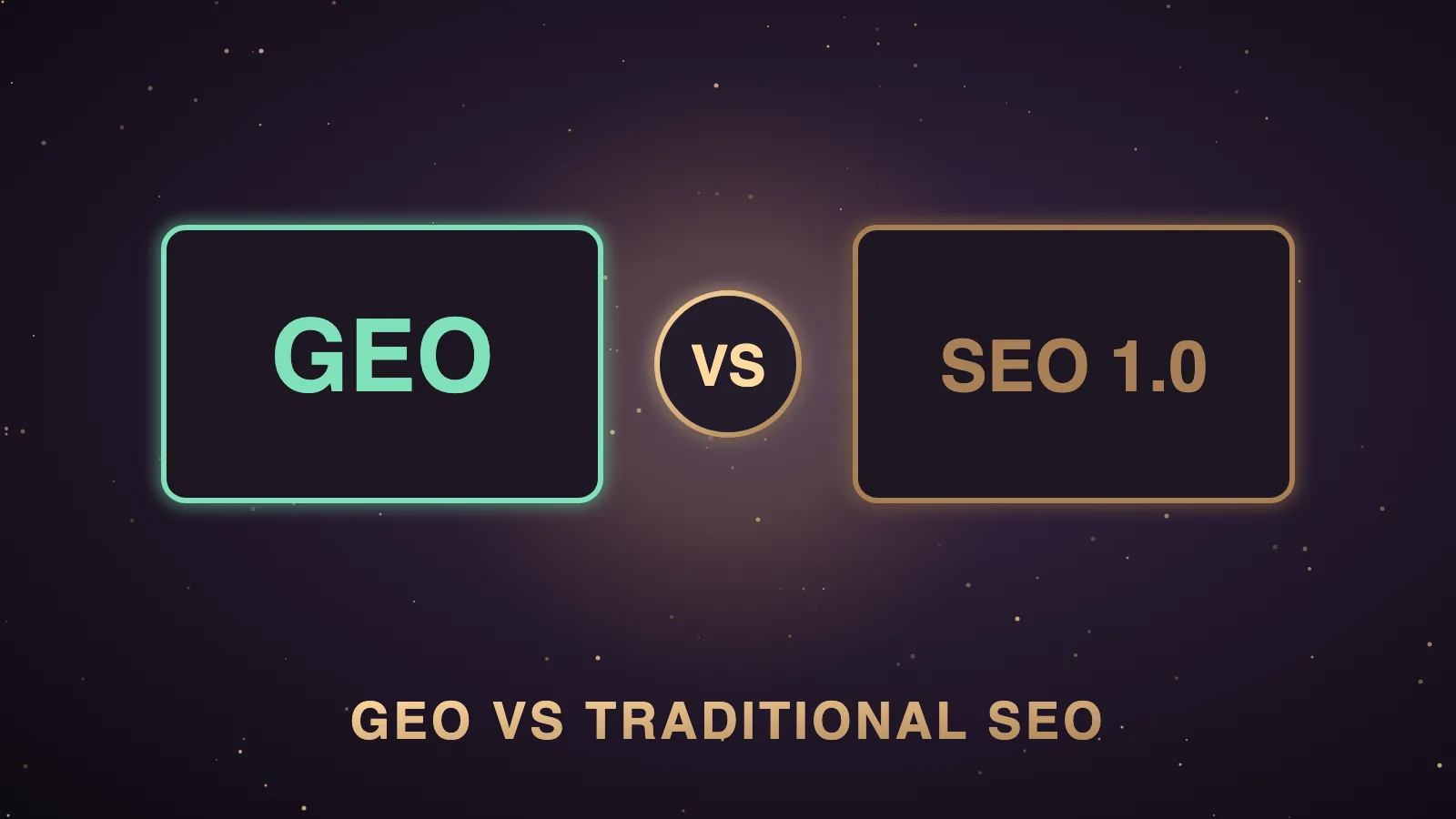
Generative engine optimization vs traditional SEO is worth understanding because the target moved: traditional SEO aimed for a place among ten blue links, and GEO aims to be one of the one to three names an AI answer gives.
The traditional foundations still matter, because the AI reads the pages that rank, but tactics that only gamed rankings don't help any more.
So the switch is to keep the basics, drop the tricks and aim for the mention instead of the position.
If you'd like my team to look at your own site, book a free one-to-one GEO, AEO AI audit and get a custom game plan.
Below you'll get the old-way-versus-new-way table, a short history, what still works, what changed and a transition plan.
Near the end, I'll look at the AI models behind the new answers, including the one the original GEO research used.
Traditional SEO vs GEO at a glance
This table shows the old way and the new way side by side.
| Traditional SEO | GEO | |
|---|---|---|
| What the searcher sees | Ten blue links. | A written AI answer naming maybe one to three businesses. |
| What position seven gets | Some clicks. | Usually nothing, because there's no room for number seven. |
| The unit of work | One page for one keyword. | Several pages and platforms that agree on you. |
| What wins | Relevance, technical health and links. | The same basics, plus real proof and fresh answers. |
| Old tricks | Keyword stuffing could sometimes move a page. | The GEO paper found keyword stuffing performed poorly. |
| Who writes what the buyer reads | You do, in your title and snippet. | The AI does, based on the pages it reads. |
The last row is the biggest change, because you no longer write the sentence the buyer sees first.
A short history: from ten blue links to generative engines
For years, a search results page was a list of links, and SEO was the work of climbing that list.
If you ranked seventh, you still got some clicks, because people scrolled, compared and picked.
That's the model I learned on, and link building on my own affiliate sites is how I ended up starting Goldie Agency.
Then search tools started writing answers instead of only listing links.
In November 2023, a team from Princeton University, IIT Delhi and two independent researchers published GEO: Generative Engine Optimization.
The paper named the new kind of search tool a generative engine, meaning one that gathers information from several sources and summarises it with a large language model.
It was accepted to the KDD 2024 conference, and it gave the new discipline its name.
What is traditional SEO?
Traditional SEO is search engine optimisation for a page of ranked links.
It covers technical health, pages that match what people search for, and links from other sites.
Its main report is rankings and clicks.
What is GEO?
GEO is generative engine optimisation, which is the work of getting your business named inside an AI answer.
That covers Google AI Overviews and AI Mode, plus ChatGPT, Gemini, Perplexity and Claude.
Its main report is who the AI names, which pages it cites and how accurately it describes you.
Why the traditional foundations still matter
The AI reads the pages that rank and sums up what they say.
I compare it to five friends recommending the same restaurant, because if five good pages agree on a name, the AI repeats it.
Google's AI features and your website page says the best practices for SEO remain relevant, with no additional requirements for AI Overviews or AI Mode.
It says a page must be indexed and eligible to show with a snippet before it can be a supporting link in those features.
It also lists the same fundamentals as before, such as allowing crawling in robots.txt, internal links, page experience, text content and structured data that matches the page.
What changed
The goal changed from a position to a mention.
The unit of work changed from one page to several pages and platforms that agree on you.
The content changed too, because the GEO paper found that adding citations, quotations and statistics helped visibility, while keyword stuffing performed poorly.
One finding surprised me more than the rest.
In the paper's experiments, the Cite Sources method raised visibility by 115.1% for sources ranked fifth in the search results, while the top-ranked source's visibility fell by 30.3% on average.
The authors read that as a chance for smaller sites, because generative engines respond to what's on the page and not only to backlinks.
That was a research setup rather than a live Google test, so I treat it as a direction, not a promise.
📞 Want to know which old tactics are holding you back?
Book a free AEO SEO strategy session and my team will look at your site, your competitors and the keywords you're closest to winning.
What to keep, change and drop
| Traditional tactic | Verdict | Why |
|---|---|---|
| Crawlability and indexing | Keep | It's the entry ticket to Google's AI features. |
| Internal links and page experience | Keep | Google still lists both as best practices. |
| Link building | Change | Links still help pages rank, and trusted mentions help the AI see agreement. |
| Structured data | Change | Keep it accurate, because Google says there's no special AI schema. |
| One page per exact-match keyword | Change | One strong answer-first page usually serves the whole question better. |
| Keyword stuffing | Drop | The GEO paper found it performed poorly. |
| Thin pages without experience | Drop | The AI has no reason to cite a page with nothing original. |
The new moves I add on top
I call my GEO system the answer engine, and it has three moves.
Be the source means every page carries a real case study, because the AI can't write about a test only you ran.
Be everywhere means multiple websites, each with a different angle, all pointing to the same answer, which is how I show up two to four times on page one.
Be first means publishing within 24 hours of a topic appearing, like "Jev architecture" and "Jev waitlist" the weekend Jev AI dropped.
What the switch looked like on my screens
In my latest video, Google's AI answer for "best geo expert" shows my content at the top, and I rank first organically too.
In AI Mode, asking for the best GEO experts to follow in 2026 lists me first and links to my sites.
In my GEO video, the AI Overview for "best HARO agency" lists five suppliers and links Goldie Agency first, which also ranks first organically.
One of my sites went from zero to about 1,300 Google clicks a day, and on one day it got over 9,600 impressions inside Google's AI features.
These are my own results from my own screens, one of my sites flopped, and nobody can guarantee what an AI answer will say.
How reporting changes
Traditional SEO reporting was mostly rankings and clicks, and you still want both.
Google says traffic from AI Overviews and AI Mode is counted inside the normal Search Console totals under the "Web" search type.
There's no separate AI report, and in my latest video I say that Google and the AI engines don't report AI traffic well yet.
So I add a weekly log of the same buyer questions, recording who the AI names, which pages it cites and whether it describes me accurately.
That log is the new-way version of a rank tracker, and it sits beside the old reports rather than replacing them.
A transition plan that keeps what works
- Keep every page that already ranks, because the AI is already reading it.
- Check each item on Google's best-practice list and fix anything that fails.
- Merge thin pages written for tiny keyword variations into stronger answer-first pages, without breaking live URLs.
- Rebuild your top ranking pages around real case studies, with sources and real numbers.
- Publish one topic on a second site or platform from a different angle.
- Publish a first page within 24 hours when something new happens in your niche.
- Fact-check every page by hand before it goes live, then add a weekly check of who the AI names.
In my latest video I run this with free tools: a Search Console CSV, Hermes Agent, which is free and open source, and an SEO skill that writes from a case-study angle.
Google's page on using generative AI content, updated on 1 October 2026, says it's "critical" to fact-check AI content manually, so that last step is a human job.
If you want help with the order, book a free strategy session and my team will pick your first pages.
Two ways to get help
The first is the free AEO SEO strategy session, which I call a free one-to-one GEO, AEO AI audit, and it's a call rather than a written report.
The second is the AI Profit Boardroom, with my Agent OS, a search OS that finds GEO keywords from your own Search Console data, my SEO skill, four coaching calls a week and 3,400+ members.
📞 Ready to move from the old way to the new way?
Claim a free strategy session and leave with a plan to rank in Google and AI search.
The models behind the new answers, on GoldieBench
Traditional SEO and GEO aren't AI models, so neither has a GoldieBench score.
The original GEO paper ran all of its experiments with GPT-3.5 Turbo, an older OpenAI model that isn't on GoldieBench.
The answers people see today come from much newer models, and here's how the relevant makers' current models score on their live GoldieBench pages.
| Model | Maker | Assistant it's linked to | GoldieBench average |
|---|---|---|---|
| Claude Opus 5 | Anthropic | Claude | 8.27 |
| GPT-5.6 Sol | OpenAI | ChatGPT | 8.16 |
| Gemini 3.6 Flash | Gemini | 7.08 |
GPT-5.6 Sol is the only OpenAI model on the board, and Gemini 3.6 Flash is the only Google model.
Google says AI Overviews and AI Mode may use different models and techniques, so the board can't tell you which model writes a given answer.
Why newer models don't change the GEO vs traditional SEO answer
GoldieBench measures one-shot builds, which is a different job from deciding which business to name.
A newer model may summarise better, but it still summarises the pages it finds.
That's why the traditional foundations still matter, because they decide which pages reach the model.
Where model quality matters is your own transition work, such as analysing Search Console data or drafting rewrites from your case studies.
For that, I'd pick a model that follows detailed instructions well and still fact-check every line.
Related reading on GoldieBench
My GEO vs SEO post explains how the two depend on each other and how to measure both.
My GEO vs AIO post explains the two meanings of AIO.
My free GEO audit post helps you check your site before you change anything.
Also On Our Network
- Agent Operatorsa four-step operator switch to GEO
- AI Income Deskwhat the switch means for a business
- AI Tool Verdicttwelve traditional SEO tactics rated
- agentos.guidethe old SEO workflow versus an agent workflow
- agentos.guidemy AEO audit guide on agentos.guide
Keep the foundations, drop the tricks and aim for the mention, and you'll be on the right side of generative engine optimization vs traditional SEO.
FAQ
What is the difference between generative engine optimization vs traditional SEO?
Traditional SEO aims for a position among ten blue links, while GEO aims to be one of the few names an AI answer gives. With AI answers there's no room for number seven.
Does traditional SEO still work?
Its foundations do. Google says SEO best practices remain relevant for AI Overviews and AI Mode, and a page must be indexed and snippet-eligible to appear.
What did the GEO research paper find about traditional SEO tactics?
It found keyword stuffing performed poorly in generative engine answers, while adding citations, quotations and statistics improved visibility.
Which model did the GEO paper use?
The paper used GPT-3.5 Turbo for all of its experiments and also tested its methods on Perplexity.ai. GPT-3.5 Turbo is not on GoldieBench.
How do today's models score on GoldieBench?
Claude Opus 5 averages 8.27, GPT-5.6 Sol 8.16 and Gemini 3.6 Flash 7.08. GoldieBench measures one-shot builds, not which businesses a model names.
Is the free strategy session a written report?
No. It is a one-to-one call where my team looks at your site, your competitors and the keywords you're closest to winning, then gives you a custom game plan.
Keep reading
 Hermes Herald AI Agent: Which Brain To Run It On, With Real GoldieBench Scores
 GEO Examples: Four Real AI Overview Wins, The Three Moves Behind Them, And The Models Writing The Answers
 Best Generative Engine Optimization Agency: Seven Picks By Region, And How The Models Behind AI Answers Score
🌐 Sister-site take: read this on agentos.guide