GoldieBench Blog · 8 min read
Hermes Import Agent: What It Moves From Claude Code And Codex, How To Use It, And The Model To Run Afterwards
Hermes import agent explained: what hermes import-agent moves from Claude Code, Codex and Cursor, how sync works, and which model to run once you've moved.
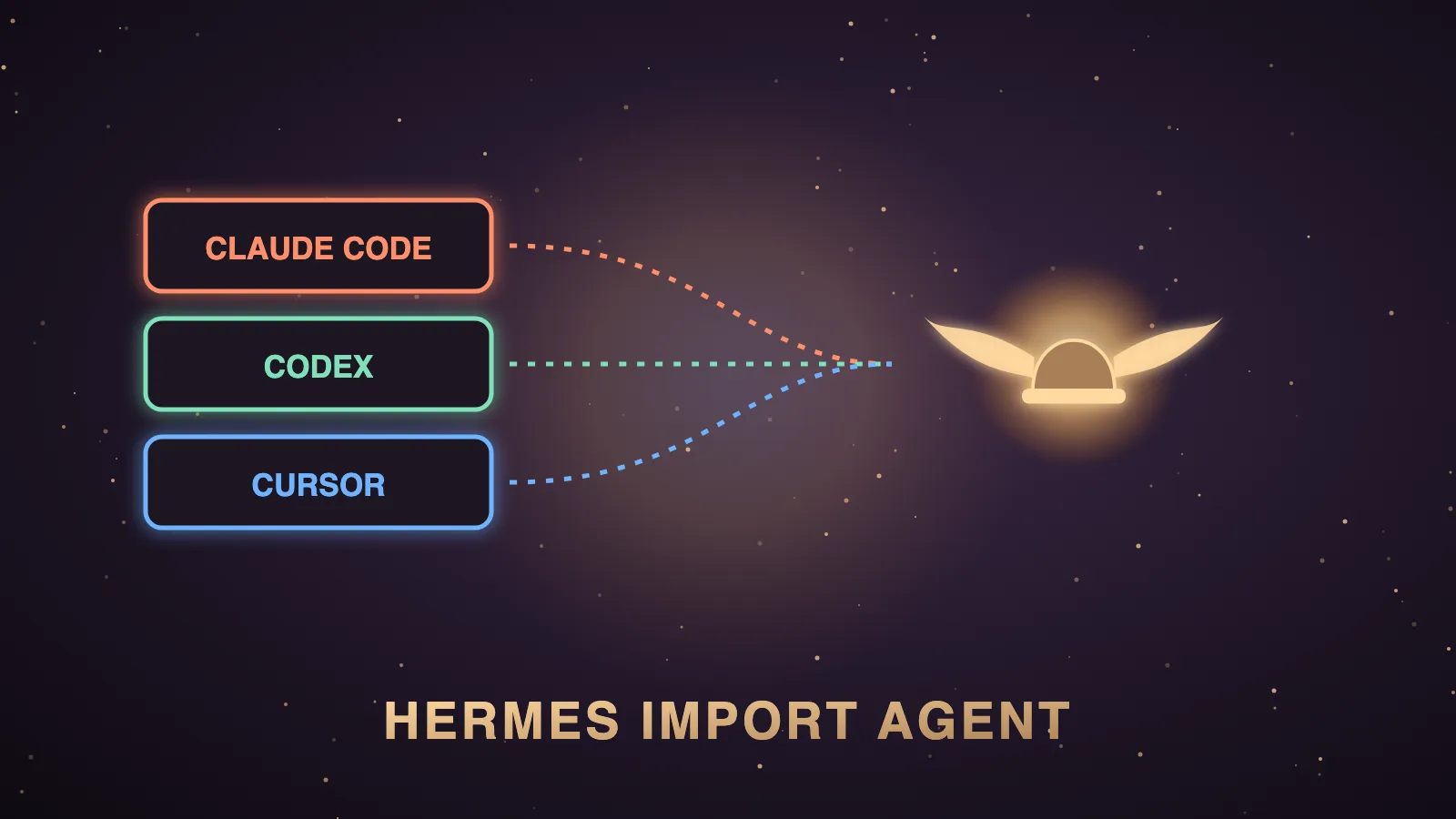
Hermes Import Agent is the hermes import-agent command in Hermes Agent, which imports a Claude Code or Codex CLI setup into Hermes in one command.
It moves your instructions, Bash permission rules, MCP servers, skills and memories, and the official Import from Other Agents page documents every mapping.
It always shows a preview before writing anything, and it never imports API keys or credentials.
The official agent-importers plugin adds Cursor, which the v0.22.4 release notes describe as "now with Cursor."
I'm Julian Goldie, and when I covered Hermes v0.20 I listed hermes import-agent claude-code as the one-line way to bring a Claude Code setup across.
I'll explain what the command does, how to run it, how sync works and how it differs from hermes import, and then I'll show you which models to run once you've moved.
Hermes Import Agent at a glance
These are the commands you'll actually use, copied from the official docs.
| Step | What you do | Command |
|---|---|---|
| 1 | You preview the import and write nothing. | hermes import-agent claude-code --dry-run |
| 2 | You import from Claude Code. | hermes import-agent claude-code |
| 3 | You import from Codex CLI instead. | hermes import-agent codex |
| 4 | You let Hermes auto-detect ~/.claude or ~/.codex. | hermes import-agent |
| 5 | You point at a custom config folder. | hermes import-agent codex --source /path/to/.codex |
| 6 | You replace conflicts and skip prompts. | hermes import-agent claude-code --overwrite --yes |
| 7 | You pull in later changes. | hermes import-agent --sync |
What is Hermes Import Agent?
Hermes Agent is the free, open-source AI agent from Nous Research, released under the MIT licence.
Hermes Import Agent is its migration command, and the CLI help calls it a "one-command import of another coding agent's setup into Hermes."
It follows the same preview-first pattern as hermes claw migrate, the command Nous points OpenClaw users to.
On my machine, which runs Hermes v0.22.1, hermes import-agent --help lists two agents, claude-code and codex.
What moves from Claude Code
| Claude Code | Where it lands in Hermes |
|---|---|
CLAUDE.md global instructions | Memory entries in ~/.hermes/memories/MEMORY.md |
permissions.allow Bash rules | command_allowlist in config.yaml |
permissions.deny Bash rules | approvals.deny in config.yaml |
mcpServers from ~/.claude.json and settings.json | mcp_servers in config.yaml |
Skill folders with a SKILL.md | ~/.hermes/skills/claude-code-imports/ |
commands/*.md slash commands | They are skipped with a note telling you to convert them into skills. |
A Claude rule such as Bash(npm run test:*) becomes the Hermes glob npm run test*.
Non-Bash rules such as Read(...) and WebFetch gate Claude-only tools, so they're reported as unmapped.
What moves from Codex CLI
| Codex CLI | Where it lands in Hermes |
|---|---|
AGENTS.md global instructions | Memory entries in MEMORY.md |
[mcp_servers.*] in config.toml | mcp_servers in config.yaml |
memories/*.md | Memory entries in MEMORY.md |
Skill folders with a SKILL.md | ~/.hermes/skills/codex-imports/ |
What never moves
The docs say API keys and credentials are never imported.
Credential files such as ~/.claude/.credentials.json and ~/.codex/auth.json are never read.
MCP environment variables or headers with secret-looking names are stripped and listed in the report, so you can re-add them deliberately.
You then run hermes setup to configure providers, or add secrets to ~/.hermes/.env.
How to run Hermes Import Agent safely
Update Hermes first with hermes update on a command-line install.
Take a restore point with hermes backup, which writes a full backup zip of your Hermes home.
Run the dry run, read the plan, and look closely at anything listed as a conflict or as unmapped.
Run the real import, then add your keys back with hermes setup.
In a non-interactive session the import stops at the preview unless you pass --yes.
Memory entries are merged and deduplicated, and conflicting MCP servers or skills are skipped unless you pass --overwrite.
A broken settings.json or config.toml becomes a per-item error in the report while everything else still imports.
How sync works
Every successful import registers its source and a digest of what it read in ~/.hermes/import-sync.json.
hermes import-agent --sync re-imports every source whose files changed, and hermes import-agent --sync --dry-run previews it.
The docs say sync is prompt-free and cheap, so it's safe to run on a schedule such as a daily cron job.
Skills you created or edited yourself under the import category are never overwritten, and credential refreshes never trigger a sync.
The manifest is per profile, and hermes profile create work --clone --sync-imports carries it into a cloned profile.
Importing from Cursor
agent-importers is an official Nous Research plugin, and its README says the command was "formerly built into Hermes Agent core."
You install it with hermes plugins install agent-importers, and the README lists hermes import-agent cursor, which reads ./.cursor.
It maps Cursor's AGENTS.md and User Rules into memory, mcp.json servers into config.yaml, and skills into skills/cursor-imports/.
The README notes that on a Hermes version with import-agent still built in, the plugin stays inert and the built-in command runs.
So check hermes import-agent --help after installing to see whether cursor appears.
Hermes Import Agent vs hermes import
| Command | What it does | When to use it |
|---|---|---|
hermes import-agent | It merges another agent's setup into Hermes. | You're moving across from Claude Code, Codex or Cursor. |
hermes import | It restores a Hermes backup zip and overwrites matching files. | You want an old Hermes home back. |
The docs example for a restore is hermes import ~/hermes-backup-20260423.zip, and they warn you to stop the gateway first.
Since v0.22.0, hermes import refuses damaged archives before anything is written.
Coming from OpenClaw instead
The Hermes docs point OpenClaw users to hermes claw migrate rather than hermes import-agent.
The newest agent-importers README also lists hermes import-agent openclaw as the new spelling of that same migration.
It says hermes claw migrate keeps working and runs the same code.
OpenClaw is a bigger move than Claude Code or Codex, because it covers persona, memories, model settings and messaging settings too.
Its secrets only come across with an explicit --migrate-secrets flag, which is a sensible default.
Common Hermes Import Agent problems and fixes
| Problem | Why it happens | Fix |
|---|---|---|
| Nothing was written | Non-interactive sessions stop at the preview. | Pass --yes once you've checked the plan. |
| An MCP server or skill was skipped | It already existed in Hermes, so it counted as a conflict. | Re-run with --overwrite after a dry run. |
| An imported MCP server fails | Its secret environment variables were stripped. | Re-add the keys listed in the import report. |
| Slash commands are missing | commands/*.md files have no direct Hermes equivalent. | Rebuild them as Hermes skills. |
Read(...) rules didn't import | Non-Bash rules gate Claude-only tools. | Set equivalent Hermes approvals yourself. |
| Cursor isn't in the help output | Your install is still running the built-in command. | Use the Claude Code or Codex import for now. |
A simple migration plan for your first week
On day one, I'd take a backup, run the dry run and read every line of the plan.
Then I'd run the real import and connect a provider with hermes setup.
Next, I'd re-add the MCP secrets that the report listed as stripped, one server at a time.
After that, I'd rebuild my most-used slash commands as Hermes skills.
Once everything works, I'd schedule hermes import-agent --sync as a daily job so both agents stay in step.
Finally, I'd run the same real task in both agents and compare the results before deciding which one owns which job.
Does Hermes Import Agent bring your model across?
No, it doesn't, and that's the part most people miss.
The agent-importers README says it makes "no network calls and no model calls," and the import never touches your credential files.
So the Claude subscription or OpenAI key you used in Claude Code or Codex doesn't come with you, and you pick a provider again with hermes setup.
That makes the import the perfect moment to choose the brain on evidence rather than habit.
Which model to run after you import
GoldieBench scores models on one-shot builds, which is a fair proxy for the coding and building work most Claude Code and Codex users do.
These are the live averages for the models you were most likely using, plus two alternatives worth considering.
| Model | GoldieBench average | Where you probably met it |
|---|---|---|
| Claude Opus 5 | 8.27 | It's the top Claude model on the board, so it's a natural pick if you came from Claude Code. |
| Hermes MoA | 8.17 | It's the Hermes Mixture of Agents setup, which only makes sense once you're inside Hermes. |
| GPT-5.6 Sol | 8.16 | It's the closest benched match if you came from Codex. |
| Claude Fable 5 | 8.10 | It sits just behind Opus 5 among the Claude models. |
| Claude Opus 5.5 | 7.57 | It's newer than Opus 5 but scores lower on these one-shot builds. |
| Qwable 5 27B Coder | 7.14 | It's the best local model on the board, so it suits work that must stay on your machine. |
| Claude Sonnet 5 | 7.01 | It's the cheaper Claude option many Claude Code users default to. |
The GPT-6 models that Hermes v0.22 added aren't on the board yet, so I can't give you a GoldieBench number for them.
If you came from Claude Code on a subscription, my point is simple: the import gives you a free chance to test whether Opus 5 or Hermes MoA does your jobs better.
For a deeper comparison, read my post on the best Hermes Agent model, or browse every model on the board.
Who Hermes Import Agent is for
It's for anyone with a Claude Code, Codex or Cursor setup who wants Hermes to start with the same rules, MCP servers and skills.
It's especially useful if you plan to keep both agents, because --sync stops the two setups drifting apart.
It's less useful if you rely on slash commands or non-Bash permission rules, because those still need rebuilding by hand.
If you're also exploring Nous Research's experimental plugins, my post on Hermes Labs covers them.
Also On Our Network
- Agent Operatorshow to move Claude Code into Hermes, step by step
- AI Income Desksix ways a team can use Hermes Import Agent
- AI Tool VerdictHermes Import Agent reviewed, with what moves and what doesn't
- agentos.guidethe Hermes Import Agent quick start for an Agent OS
- agentos.guidemy Hermes v0.20 guide on agentos.guide
If you run an SEO business and want to talk through moving your agents into Hermes, you can book a free SEO strategy session with my team.
If you'd like a second pair of eyes on which model should run your agency's jobs, my team can cover that in a free SEO strategy session too.
Dry-run it, import it, then pick the brain from the live board, and you'll get the most out of Hermes Import Agent.
FAQ
What is Hermes Import Agent?
Hermes Import Agent is the hermes import-agent command in Hermes Agent. It imports a Claude Code or Codex CLI setup into Hermes in one command, previews before writing and never imports API keys. The official agent-importers plugin adds Cursor.
What does hermes import-agent move?
From Claude Code it moves CLAUDE.md into memory, Bash allow and deny rules into config.yaml, MCP servers and skills. From Codex it moves AGENTS.md, memories, MCP servers and skills. Slash commands are skipped with a note.
Does Hermes Import Agent bring my model or API key across?
No. It never reads credential files, and the agent-importers plugin makes no network or model calls. You choose a provider again with hermes setup after the import.
Which model should I run after importing into Hermes?
On GoldieBench one-shot builds, Claude Opus 5 averages 8.27, Hermes MoA 8.17 and GPT-5.6 Sol 8.16. Claude Opus 5.5 averages 7.57, and Qwable 5 27B Coder averages 7.14 as the best local option. The GPT-6 models are not benched yet.
What is the difference between hermes import-agent and hermes import?
hermes import-agent merges another agent's setup into Hermes. hermes import restores a Hermes backup zip and overwrites matching files in your Hermes home.
How do I keep an imported setup up to date?
Run hermes import-agent --sync, which re-imports only sources whose files changed and runs without prompts, so it is safe to schedule.
Keep reading
 Hermes Herald AI Agent: Which Brain To Run It On, With Real GoldieBench Scores
 GEO Examples: Four Real AI Overview Wins, The Three Moves Behind Them, And The Models Writing The Answers
 Best Generative Engine Optimization Agency: Seven Picks By Region, And How The Models Behind AI Answers Score
🌐 Sister-site take: read this on agentos.guide