GoldieBench Blog · 3 min read
Muse vs Instinct: The Verdict, Backed By The Only Model Data Available
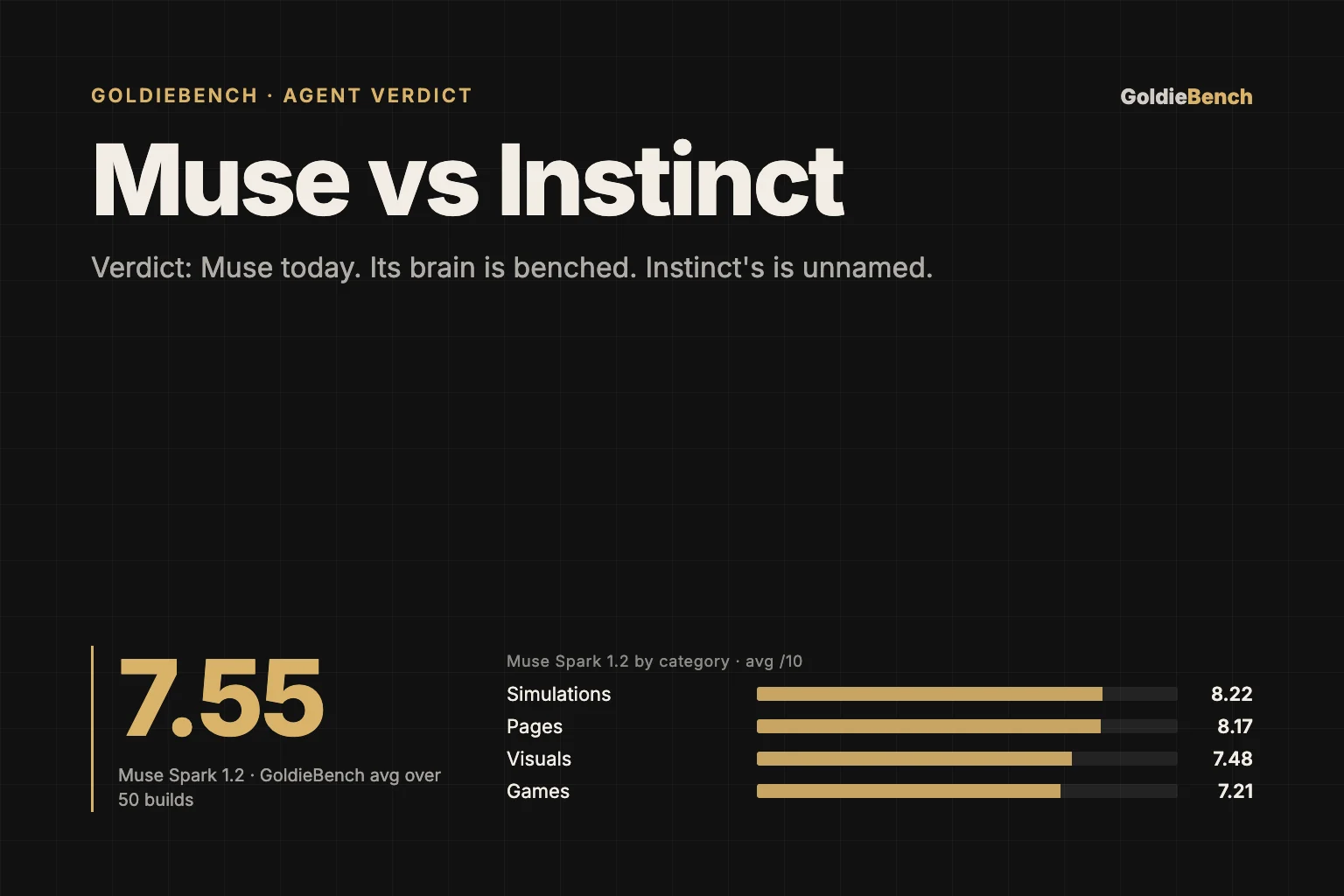
Muse vs Instinct verdict: Muse wins today. Its Muse Spark brain is benched (1.2 scores 7.55 over 50 builds); Instinct is invite-only and its model is unnamed.
Muse vs Instinct has a clear winner today, and it is Meta Muse, because it is open to the public and its brain is a model I have actually benchmarked.
Instinct is invite-only, and it has not publicly named the model it runs on.
I have not used either personal agent on my own accounts, so this is a researched verdict, not a hands-on review.
What I can add that nobody else can is real performance data on the Muse Spark family from GoldieBench.
The Muse vs Instinct verdict in one table
| Meta Muse | Instinct | |
|---|---|---|
| Launched | 8 September 2026 | Private beta, invite-only |
| Where | Web at muse.ai, iOS, Android and WhatsApp, US first | Text it or call it |
| Price | Free tier, Power at $20 a month, Maximum at $100 a month | No published price |
| Brain | Meta's Muse Spark model | Not publicly named |
| Benchmarked on GoldieBench | Yes, Muse Spark 1.2 scores 7.55 | Cannot be, because the model is not named |
| Safety design | Muse Secure VM, a separate Sentinel agent, and user approvals | Little published detail |
| Winner today | ✓ |
If you want an agent this week and you are in the US, pick Muse.
If you get an Instinct invite and want an assistant you can ring, it is worth a careful try with no work accounts connected.
What is under the hood of Muse
TechCrunch reports that Muse is powered by Meta's Muse Spark model and runs on a dedicated Muse Secure VM.
Several reviews report the launch version as Muse Spark 1.3.
I benchmarked Muse Spark 1.2 on release day, 5 August 2026, when Meta shipped it beside the Muse Code agent.
So my numbers are for the version just before the one under Muse, and I will not pretend otherwise.
Muse Spark 1.2 on GoldieBench, in detail
It ran all 50 tasks and averages 7.55.
That puts it right beside Claude Opus 5.5 at 7.57 and just ahead of Opus 4.8 at 7.51.
It picked up 3 silver and 4 bronze task medals, and no golds.
| Category | Muse Spark 1.2 avg | Tasks |
|---|---|---|
| Simulations | 8.22 | 12 |
| Pages | 8.17 | 3 |
| Visuals | 7.48 | 9 |
| Games | 7.21 | 23 |
| Other | 7.10 | 3 |
Its best builds were the fractal at 8.7 and aurora, galaxy, matrix, orbit, synthwave and a macOS-style desktop at 8.6.
Its weakest were dragonflight and the Skyrim-style world at 4.2, and the crypt at 4.5.
So Muse Spark is strong at structured interfaces and simulations, and shakier on big open 3D worlds.
For a personal agent, the interface and planning strength matters far more than 3D games, which is good news for Muse.
It is also cheap as API models go, at $1.25 per million input tokens and $4.25 per million output tokens, with a 1M-token context.
Why Instinct cannot be scored
I cannot benchmark a model nobody will name.
That is not a judgement that Instinct's brain is worse.
If it runs on a frontier model, the top of the board looks like Claude Opus 5 at 8.27 and GPT-5.6 Sol at 8.16, both above Muse Spark 1.2.
But "if" is doing a lot of work in that sentence.
Instinct was founded by Noah Shinn, an early research scientist at Sierra and first author of the Reflexion paper, which tells you the team is serious.
It still has to show what it runs on before anyone can compare it fairly.
Muse vs Instinct for builders and operators
If you run agents for a business, the personal-agent fight matters less than the models underneath.
The same Muse Spark family powers Muse Code, Meta's coding agent, and you can call the model directly through the API.
That means you can route it inside your own stack for the jobs it is good at, such as dashboards, app shells and simulations.
Keep the 3D world builds on a model that scores higher there, such as GPT-5.6 Sol, which averages 8.17 on games.
You can compare the two side by side on the Muse Spark 1.2 vs GPT-5.6 Sol head-to-head.
The final Muse vs Instinct call
Muse wins on access, price transparency, published safety design and a brain with public benchmark data behind it.
Instinct wins on the most natural interface, because you just text or call it.
Until Instinct opens up and names its model, Muse is the one I would put my name behind.
That is my Muse vs Instinct verdict, and I will re-run it the day Instinct names its model.
FAQ
Is Muse better than Instinct?
For most people today, yes. Muse is public in the US with a free tier and paid plans at $20 and $100 a month, and its Muse Spark model family is benchmarked on GoldieBench. Instinct is invite-only and has not named its model.
What model does Meta Muse run on?
Meta's Muse Spark model; several reviews report the launch version as Muse Spark 1.3. GoldieBench benched Muse Spark 1.2, which averages 7.55 over 50 one-shot builds.
How good is Muse Spark at building things?
Muse Spark 1.2 averages 8.22 on simulations and 8.17 on pages, but 7.21 on games, with its weakest open-world builds at 4.2.
What model does Instinct use?
Instinct has not publicly named its model, so it cannot be benchmarked on GoldieBench.
Who makes Instinct?
Instinct was founded by Noah Shinn, an early research scientist at Sierra and first author of the Reflexion paper. It is in an invite-only private beta.
Keep reading
 Hermes Herald AI Agent: Which Brain To Run It On, With Real GoldieBench Scores
 GEO Examples: Four Real AI Overview Wins, The Three Moves Behind Them, And The Models Writing The Answers
 Best Generative Engine Optimization Agency: Seven Picks By Region, And How The Models Behind AI Answers Score
🌐 Sister-site take:
- 📺 Video notes + links to the tools
- 🆓 Get a FREE AI course + community + 1,000 AI agents
- 🎥 Learn how I make these videos