GoldieBench Blog · 10 min read
How To Learn AI Agents From Scratch: A Zero-Jargon Path For Your First 14 Days
How to learn AI agents from scratch with no coding: one easy setup, 3 tiny tasks, a 14-day plan, a glossary, and what a model is with real bench scores.
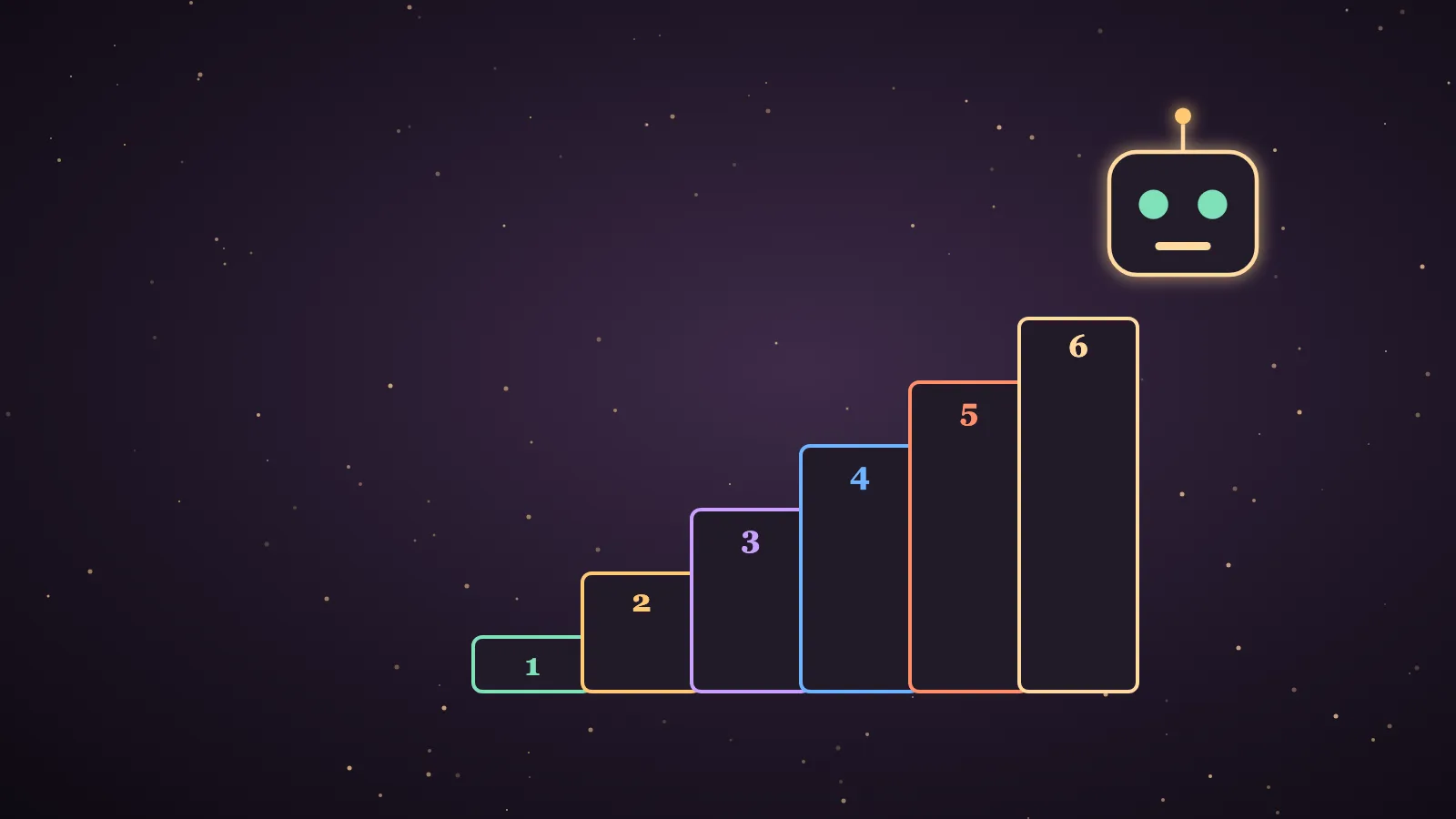
How to learn AI agents from scratch is easier than the jargon makes it look, because you only need one agent, one free model and one small job a day for two weeks.
I'm Julian Goldie, and I've written this for someone who has never opened a terminal and has no idea what an API key is.
Every technical word on this page is explained the first time it appears.
You won't write any code, and you can do the whole thing on a free model.
The short answer: how to learn AI agents from scratch
- You learn what an AI agent is, which takes about ten minutes.
- You install one agent as a normal desktop app.
- You give it three tiny tasks so you can watch it work.
- You learn three words, which are model, provider and API key.
- You make sure you're using a free model.
- You schedule one job, which is your first automation.
- You save that job as your first skill.
That list is the whole method, and the rest of this page spreads it over 14 short days.
What an AI agent is, without the jargon
A chatbot talks, and an AI agent acts.
Think of a car, where the agent is the driver and the model is the engine.
The driver knows where you want to go, chooses the route and uses the controls.
The engine provides the power, and you can fit a bigger or a smaller one.
When you give an agent a goal, it makes a plan, uses a tool such as web search or a file, checks what happened and carries on until the job is done.
That plan, act and check loop is the one idea you need on day one.
The agent in my examples is Hermes Agent, which is a free, open-source agent from Nous Research.
Setting up your first agent the easy way
There are three easy routes, and none of them asks you to write code.
| Route | What you do | Cost | Good to know |
|---|---|---|---|
| Hermes Desktop | You download the official app, open it, sign in to Nous Portal and pick a model marked free. | The app is free. | The Mac package is for Apple Silicon only. |
| Hermes Cloud | You sign in on the Nous Portal website, create an agent and pick a free model. | It's a paid hosted product. | Nothing runs on your own computer. |
| One-click with Ollama | You install the free Ollama app, keep it running and paste one launch command. | It's free, with token limits on cloud models. | It uses a terminal for one paste. |
I'd start with Hermes Desktop, because it installs like any other program.
On a Mac you open the DMG file and drag Hermes into Applications, and on Windows you open the download with Windows App Installer.
Then you sign in, choose a free model, type "test" and wait for a reply.
Hermes Cloud is the route for an old computer, and you should check its current price on the page before you deploy.The video at the top of this page shows the one-click route with Ollama, which takes about 20 seconds once Ollama is running.
My best Hermes Agent setup post compares the bigger setups for later.Your first 14 days, day by day
Each day is one small task, and most of them take under half an hour.
| Day | Your task | Rough time |
|---|---|---|
| 1 | You learn what an agent is and write down one boring job you'd hand over. | 15 minutes |
| 2 | You install one agent and get a reply to the word "test". | 30 minutes |
| 3 | You run three tiny tasks. | 30 minutes |
| 4 | You learn what a model, a provider and an API key are. | 20 minutes |
| 5 | You check that your model is marked free and choose a backup. | 15 minutes |
| 6 | You write a short note about yourself for the agent to read. | 20 minutes |
| 7 | You join a free community and post what you've done. | 15 minutes |
| 8 | You run one real job by hand until the result is usable. | 40 minutes |
| 9 | You put that job on a schedule. | 20 minutes |
| 10 | You read the first automatic result and improve the instructions. | 20 minutes |
| 11 | You save the job as a skill. | 20 minutes |
| 12 | You reuse the skill on something new. | 20 minutes |
| 13 | You take your hardest problem to a community or a live call. | 30 minutes |
| 14 | You write down the agent's second job. | 15 minutes |
The times are my rough guide for a beginner, and they aren't measured.
Your first three tiny tasks
On day three, you run three small tasks to see the plan, act and check loop for yourself.
First, paste a link and type "Read this page and give me the five most useful points in plain English."
Second, type "Write a shopping list for a week of simple dinners and save it as a file on my computer."
Third, type "Find three free apps for learning a language, compare them in a table and recommend one."
The first task shows the agent using a web tool.
The second task shows the agent creating a real file on your machine.
The third task shows the agent working through several steps without you.
If one of them fails, ask again in simpler words, because that's normal on a free model.
What an API key, a model and a provider are
These three words appear on every settings screen, so they're worth ten minutes.
| Word | Plain meaning | In the car picture |
|---|---|---|
| Agent | It's the program that plans the work and uses tools. | It's the driver. |
| Model | It's the AI brain the agent thinks with. | It's the engine. |
| Provider | It's the company that runs the model for you. | It's the garage that supplies the engine. |
| API key | It's a long password that connects your agent to a provider. | It's the key to the garage. |
| Token | It's a small piece of text, and usage is counted in tokens. | It's the fuel gauge. |
Hermes Agent doesn't come with one fixed model, so you can change the engine without changing the driver.
You don't need an API key for this plan, because Hermes Desktop lets you sign in to Nous Portal instead.
If you get a key later, keep it private, because anyone who has it can use your account.
Using a free model
The agent is free, so the model is the only part that could cost you money.
Open the model settings and choose an entry that is marked free.
Some models appear in both a free version and a paid version, so read the label carefully.
Free models have rate limits, which are caps on how much you can use in a set time.
Pick a second free model as a backup for busy times.
Free lists change, so learn the habit of checking and don't memorise one name.
My Solar Mini 4 walkthrough shows a free model being set up click by click.Your first automation
An automation is a job that runs on a schedule without you asking for it.
On day eight, pick the boring job from day one and run it once by hand.
A good example is "Read these three pages and write me a ten-line morning brief."
On day nine, tell the agent when to run it, such as "Do this every weekday at 7am."
Hermes also has Automation Blueprints, which let you fill in a recipe instead.
On day ten, read the first result and add a line of instruction for anything you didn't like.
The honest limit is that an agent on your laptop only runs while the laptop is on and the app is open.
My Hermes use cases post lists more automations to try next.Your first skill
A skill is a saved set of instructions that tells the agent how to do one kind of job.
In Hermes, a skill is a folder with a text file called SKILL.md inside it, so it's still plain English.
After a job has gone well, type /learn in the chat and ask Hermes to turn the workflow it just ran into a skill.
On day twelve, open a new chat and use the skill on a different input.
If it works twice, you own a repeatable process.
My Hermes skills post covers the bundled skills worth trying after your own.What you do NOT need to learn yet
You can leave all of these alone for your first 14 days.
| Topic | Why it can wait |
|---|---|
| Coding | Every step here is typed in plain English. |
| Fine-tuning | Clear instructions and a skill get you most of the way. |
| Vector databases | A short note is enough memory for a beginner. |
| Agent frameworks | You're using a finished agent, so you don't need to build one. |
| Multi-agent teams | One agent with one job teaches you more. |
| Running models on your own computer | A free hosted model is easier on day one. |
| Servers | Your own computer is enough for the first month. |
When you want the developer route later, the Hugging Face AI Agents Course and Microsoft's AI Agents for Beginners both describe themselves as free.
I haven't taken either course, so I'm only repeating what their own pages say.
How to get unstuck
Getting stuck is part of learning, so here's what I'd do in order.
First, ask the agent what went wrong, because it can often explain its own mistake.
Second, make the request smaller and try again.
Third, post the exact error and a screenshot in a community.
My free community is AI Money Lab, and it's the right place for beginner questions.
The AI Profit Boardroom has 3,400+ members and four coaching calls a week, so you can get live help with your own setup.
A plain-English glossary
| Word | Meaning |
|---|---|
| Tool | A tool is something the agent can use, such as web search, a browser or your files. |
| Prompt | A prompt is the instruction you type. |
| Memory | Memory is what the agent keeps between chats. |
| Profile | A profile is a separate copy of the agent with its own model and memory. |
| Skill | A skill is a saved set of instructions for one kind of job. |
| Automation | An automation is a job that runs on a schedule. |
| Rate limit | A rate limit is a cap on how much you can use a model in a set time. |
| Terminal | A terminal is a window for typed commands, and this plan avoids it. |
| Open weights | Open weights means the model's files are public, so people can run it on their own machines. |
| Agent OS | An Agent OS is a dashboard that runs several agents under one shared memory. |
What a model is worth: real GoldieBench scores for beginners
This site is a model leaderboard, so here's the part a bench reader will want.
Hermes Agent doesn't ship its own model, which means the model you choose decides how clever your agent is.
GoldieBench scores each model from 0 to 10 on one-shot builds, such as games, simulations, visuals and pages.
It doesn't score agents, courses or learning plans, so nothing above this section has a bench score.
These are the live averages for models you're likely to meet as a beginner.
| Model | Maker | Live GoldieBench average | What it costs | What it means for a beginner |
|---|---|---|---|---|
| Claude Opus 5 | Anthropic | 8.27 | It's paid. | It's a top brain, and you don't need it to learn. |
| MiniMax M3 | MiniMax | 7.97 | It's paid, at a low price. | It's a sensible first paid model later on. |
| Kimi K3 | Moonshot AI | 7.89 | It's paid. | It's strong on long jobs. |
| GLM-5.2 | Zhipu | 7.77 | It has open weights. | It's a strong value pick. |
| Qwable 5 27B Coder | DJLougen | 7.14 | It's free and runs locally. | It needs a powerful Mac, so it isn't a day-one choice. |
| Agents-A1 | InternScience | 4.83 | It's free and runs locally. | It's tuned for agent work and tool calling. |
| Gemma 4 12B MLX | 3.98 | It's free and runs locally. | It's a light model for simple jobs. | |
| Laguna XS 2.1 | Poolside | 3.93 | It has a free tier. | It's a small free model for easy tasks. |
Upstage Solar Mini 4, the free model in the video below, isn't on the board, so I can't give you a score for it.
There are two honest lessons in that table.
The first is that free and small models score lower on big one-shot builds, which is exactly what you'd expect.
The second is that your first 14 days don't involve big one-shot builds.
Summarising a page, writing a brief and saving a file are much lighter jobs, and a free model is enough to learn on.
The time to care about the top of the board is when your agent starts building apps or pages for you.
When you get there, you can put up to three models side by side on the compare page, and the free options you can run yourself are on the local models board.
The scoring rules are on the methodology page, and scores move as I re-test, so check the live model page before you choose.
Where to go after day 14
How to learn AI agents is the wider roadmap once you've finished this plan. The best AI agent course for beginners ranks the courses I'd look at if you want a class. How to learn creating AI agents covers designing an agent of your own.Also On Our Network
- Agent Operatorsmy day-by-day 14-day plan to learn AI agents from scratch
- AI Income Deskhow a business owner learns AI agents from scratch with one real job
- AI Tool Verdictthe four easiest routes to a first AI agent, rated
- agentos.guidehow one agent grows into an Agent OS
- aiprofitboardroom.comJulian's guide to learning AI agents free
Set up one agent, stay on a free model, do one small task a day, and that's how to learn AI agents from scratch.
FAQ
How do I learn AI agents from scratch?
Install one agent as a desktop app, run three tiny tasks, then give it one small job a day for 14 days. By the end you should have one scheduled automation and one saved skill, with no coding.
Do I need to code or use a terminal to learn AI agents?
No. Hermes Desktop installs like a normal app and you give instructions in plain English. The one-click Ollama route uses a terminal for a single pasted command, and Hermes Cloud needs no install at all.
What is an API key?
An API key is a long password that connects an agent to a model provider. On Hermes Desktop you can sign in to Nous Portal instead, so a beginner does not need one. If you get one later, keep it private.
Is a free model good enough to learn AI agents?
Yes. Light jobs such as summaries, briefs and saving files work on a free model. Free and small models score lower on big one-shot builds on GoldieBench, for example Laguna XS 2.1 at 3.93 against Claude Opus 5 at 8.27.
Does Hermes Agent have a GoldieBench score?
No. Hermes Agent is an agent and does not ship its own model, and GoldieBench scores models on one-shot builds. The model you connect is what has a score.
What should I not learn yet?
Leave coding, fine-tuning, vector databases, agent frameworks, multi-agent teams, local models and servers until your first automation is running.
Keep reading
 Hermes Herald AI Agent: Which Brain To Run It On, With Real GoldieBench Scores
 Herald OS: What It Is, How To Set It Up, And Which Benchmarked Models To Run Under It
 Hark AI Agent: What It Is, The Model Behind It, And How Those Brains Score On GoldieBench
🌐 Sister-site take: read this on agentos.guide