GoldieBench Blog · 11 min read
Hermes Agent OS Free: Herald OS Costs $0, So Which Free Brain Should Run It?
Hermes Agent OS free: Herald OS costs nothing, but the brain can. Real GoldieBench scores for the free and local models you can run inside it.
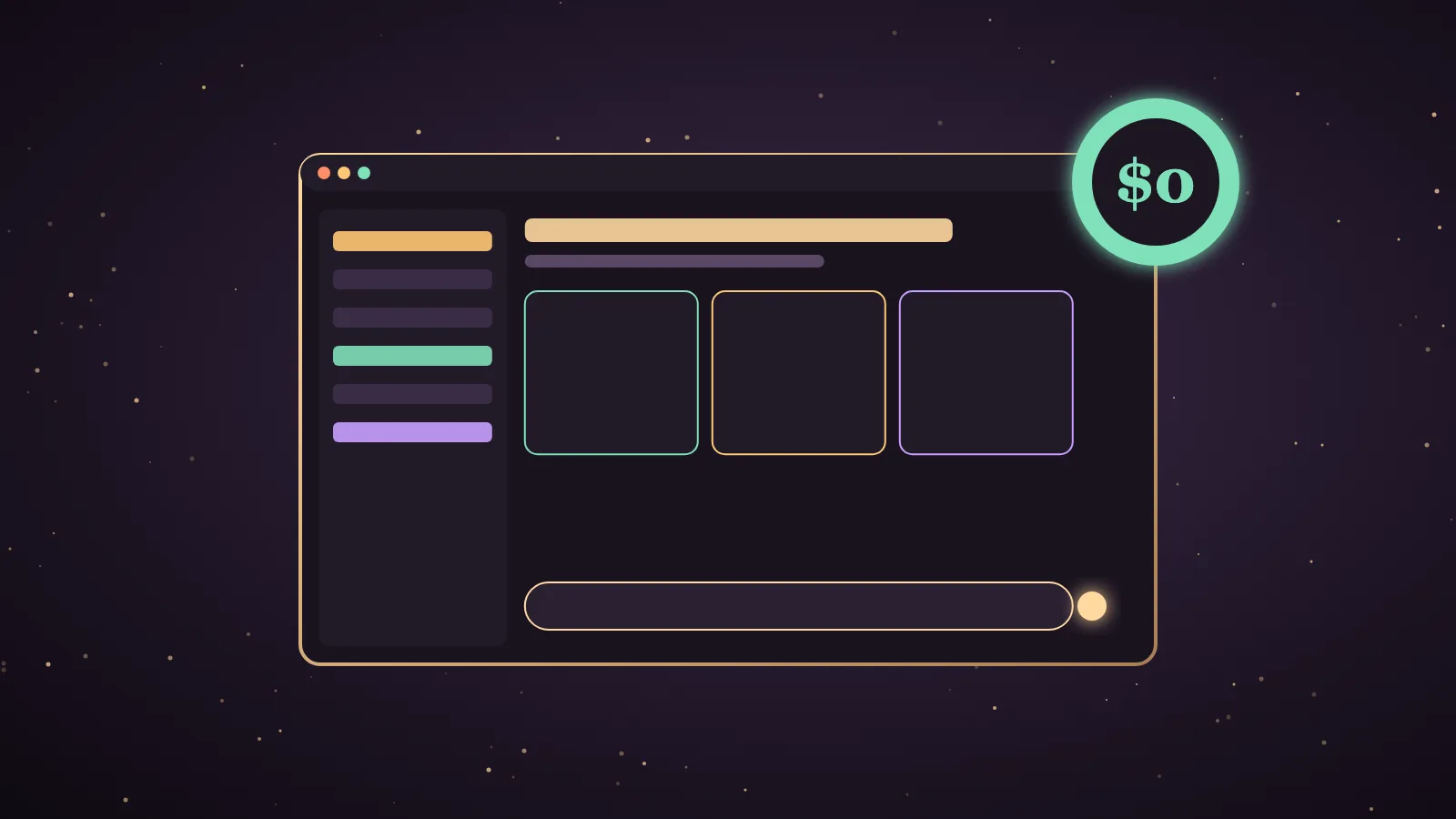
The Hermes Agent OS free option to know about is Herald OS, a free, open-source (MIT) Hermes Agent OS that wraps a full desktop around Hermes Agent.
It was built by Luke The Dev as an independent project, and it is not affiliated with Nous Research, the team behind Hermes Agent.
You pay nothing for the software itself, because the MIT licence lets you download it, use it and change the code for free.
The problem it solves is that Hermes on its own lives in a terminal, while Herald OS gives you a clean dashboard where you talk or type to one agent that runs your machine.
In this post I explain what it is, how it works, how to set it up for $0, what you can do with it and where it falls short.
After that, I cover the one part of the stack that can still cost money, and how to keep it free.
What Herald OS is, in short
Herald OS calls itself an agent-native operating system with Hermes Agent as the interface.
It's an independent project by Luke The Dev, released under the MIT licence, and it is not affiliated with Nous Research.
Nous Research publishes Hermes Agent, and Herald OS runs a standard Hermes install with its system tools added as the herald-os-bridge plugin.
The status is alpha, version 0.1.
I had Claude set it up on my Mac in about two minutes, and I think it looks nicer than Hermes Desktop.
How the free Hermes Agent OS works
Hermes Agent does the thinking and the doing, and Herald OS is the desktop you use to talk to it.
Herald OS doesn't fork Hermes, so your existing skills, memory and scheduled jobs carry straight over.
The herald-os-bridge plugin gives Hermes system tools for files, apps, processes and disk usage, each with its own permission tier.
Reading and opening things runs straight away, changing files asks first, and trashing files or stopping a program asks every time.
Because it's one shared Hermes install, automations in Herald OS sync with Hermes Desktop and any other interface on the same machine.
My Herald OS explainer covers every screen in more detail.
What's free in a Hermes Agent OS, and what isn't
| Layer | Cost | What to watch |
|---|---|---|
| Herald OS | Free, MIT licence | It's alpha, so keep backups. |
| Hermes Agent | Free and open source | It installs with the official script and hermes setup. |
| The model provider | Free or paid | This is the only layer that can bill you. |
| Free voice engine | Free | It uses on-device transcription and free Edge voices. |
| Live voice engine | Opt-in, $0.05 per minute | It runs on your own OpenAI key. |
The Herald OS README says Hermes needs a model provider, either a Nous Portal account or an API key for a provider such as OpenRouter, OpenAI, Anthropic or a local model.
The Usage page in Herald OS shows tokens used, your plan and your token balance, so you can check the bill stays at zero.
How to set up Herald OS for $0
Install Hermes Agent first with curl -fsSL https://hermes-agent.nousresearch.com/install.sh | bash, then run hermes setup.
Pick a free provider while you're in setup, and you can change it later with hermes model or in Herald OS settings.
Download the Apple Silicon DMG from the Herald OS releases page and drag it to Applications.
Run xattr -dr com.apple.quarantine "/Applications/Herald OS.app" once, because the build isn't notarised yet.
Open it, use Cmd+Ctrl+F to toggle fullscreen and Cmd+Q to quit.
You need macOS 13 or later on Apple Silicon, and there are also routes for a Linux PC, Arch, Omarchy, other Linux and a virtual machine.
What you can do with the free Hermes Agent OS
The dashboard greets you by name and shows today's schedule, what needs attention and recent screenshots from your desktop.
Spaces split your work into Ideas, Work and Personal, and you can add a space for each client.
Missions let Hermes plan a bigger goal, such as building out a new website, step by step.
Memory shows everything Hermes remembers, so check it before you share your screen.
Files lists recent, favourites, projects, downloads, shared and deleted items.
Automations let you switch routines on or off, and mine included a 6am to-do recap and morning inbox triage.
Connections is meant to hold your tools and external apps.
Settings covers background agents, approvals, voice, themes, plugins from a GitHub link, software access and the Usage page.
The free voice engine works out of the box, and the Live engine is the only voice option that costs anything.
Honest limits of Herald OS itself
Herald OS is alpha software, and the Connections section didn't work or sync for me.
The interface was cut off slightly at the top of my screen.
The Mac build isn't notarised yet, so only download it from the official releases page.
Hermes Desktop is the steadier free option if you need something further along today.
My Agent OS inside the AI Profit Boardroom is the paid route, with build tabs, Hermes profiles and coaching built around it.
Which free brain should run Herald OS?
Herald OS doesn't come with its own model, because it runs whatever model your Hermes install is set up with.
That makes the model the only layer that can send you a bill, so it decides whether your setup really stays free.
To compare the options, I use GoldieBench, the leaderboard where I score models on real one-shot builds.
I'll only use numbers from the live board, and I'll say so plainly when a model isn't benched.
What GoldieBench measures, and what it doesn't
Every model on the board gets the same one-shot prompts to build games, pages, simulations and visuals.
Each build is rendered and scored from 0 to 10, and the average is what you see on each model page.
That's a strong signal of how well a model plans and writes working code in one go.
It isn't a direct test of agent jobs like inbox triage inside Herald OS, so treat it as one input, not the whole answer.
Still, a brain that can't build reliably in one shot usually struggles on long multi-step jobs too.
The free and local brains on the board, ranked
These are the models on GoldieBench that you can run for $0, either through a free tier or on your own machine.
| Model | How it's free | GoldieBench avg | Scored tasks |
|---|---|---|---|
| LongCat-2.0 | On the Nous Portal free list when I recorded, plus open weights and a free web chat | 8.12 (provisional) | 4 |
| Qwable 5 27B Coder | Runs locally with MLX, about 15GB | 7.14 | 41 |
| Agents-A1 | Runs locally with Ollama, about 21GB | 4.83 | 45 |
| Gemma 4 12B MLX | Runs locally, about 7.7GB | 3.98 | 42 |
| Laguna XS 2.1 | Free on OpenRouter and on the Nous Portal free list | 3.93 | 42 |
| Qwythos 9B | Runs locally with Ollama, about 5.6GB | 2.98 | 42 |
LongCat-2.0 has the highest number, but only 4 tasks are scored, which is why the board marks it provisional.
Qwable 5 27B Coder is the strongest proven free option, with 7.14 across 41 tasks and a bronze medal.
It's also the top builder on the local models board, though you need enough memory to run a 15GB model well.
Agents-A1 is built for long-horizon tool work, and it averages 4.83 across 45 tasks.
Laguna XS 2.1 is the easiest free model to reach, because it's on OpenRouter's free list and the Nous Portal free list, but it averages 3.93.
So the free brain that's easiest to switch on isn't the one that builds best.
The open-weights models worth knowing
Two more models on the board publish open weights, so they matter if you plan to self-host later.
| Model | GoldieBench avg | Scored tasks | Price as listed |
|---|---|---|---|
| GLM-5.2 | 7.77 | 47 | Open weights, free for individuals |
| Qwen 3.7 | 7.00 | 47 | Open weights, free for individuals |
GLM-5.2 has 5 gold medals and a 1M-token context window.
"Free for individuals" refers to the vendor's own free access and the downloadable weights, so check the terms before you wire either one into Hermes as an API brain.
Running models this size locally needs serious hardware, which is why I put the smaller local models in the main table.
The free brains that aren't benched yet
When I recorded my Solar Mini 4 video, the Nous Portal free list showed seven models.
| Free model | On GoldieBench? | What I can tell you |
|---|---|---|
| Upstage Solar Mini 4 | No | It replied fast in my Hermes test and gave a sourced seven-day news brief, but it has no score. |
| NVIDIA Nemotron | No | It's on both the Nous Portal and OpenRouter free lists, so test it on your own jobs. |
| inclusionAI Ling 3.1 Flash | No | It isn't benched, so treat it as a backup flash model. |
| StepFun Step 3.7 Flash | No | It isn't benched, so treat it as a backup flash model. |
| Ling 3.0 Flash | No | It isn't benched, so test it before you rely on it. |
| Meituan LongCat 2.0 | Yes, provisional | It scored 8.12 across 4 tasks. |
| Poolside Laguna XS 2.1 | Yes | It scored 3.93 across 42 tasks. |
My favourite tiny local brain for Hermes, LFM 2.5 2.6B, isn't on the board either.
It's on OpenRouter's free list today, and my run Hermes free forever guide shows it running on an 8GB machine.
I won't give any of these a number they haven't earned.
Free versus paid: what the gap really looks like
The top of the board still belongs to paid models.
| Model | GoldieBench avg | Scored tasks | Price as listed |
|---|---|---|---|
| Claude Opus 5 | 8.27 | 50 | $5 / $25 per M |
| Hermes MoA | 8.17 | 47 | Panel and aggregator calls via OpenRouter |
| MiniMax M3 | 7.97 | 47 | $0.30 / 1M input, $1.50 / 1M output |
Hermes MoA is Hermes Agent's own Mixture of Agents mode, and its 8.17 shows how high Hermes can climb with strong brains behind it.
MiniMax M3 is the one I'd look at if free isn't enough, because it gets close to the top at a small input price.
Qwable at 7.14 sits about 1.1 points behind Claude Opus 5 while costing nothing per token.
That gap matters for hard builds, but it matters much less for summaries, research briefs and inbox triage.
Which free brain to run for each Herald OS job
Herald OS gives you a dashboard, Spaces, Missions, Memory, Files, Automations, Connections and Settings.
Here's how I'd match a free brain to the jobs those features run.
| Herald OS job | Free brain I'd use | Why |
|---|---|---|
| Morning inbox summaries and daily recaps | A Nous Portal free flash model, with Laguna XS 2.1 as a backup | Summaries are easy to check, and free flash models are fast. |
| Missions such as building a website | Qwable 5 27B Coder locally, or LongCat-2.0 while it stays free | They have the strongest free build scores on the board. |
| Private files and notes | A local model such as Qwable or Gemma 4 12B MLX | Nothing leaves your machine. |
| Long tool-heavy chores | Agents-A1 locally | It was built for long-horizon tool work. |
| Client-facing final work | A paid model such as MiniMax M3 or Claude Opus 5 | The board shows the quality gap is real. |
Automations in Herald OS sync with Hermes Desktop and other interfaces on the same Hermes install, so the brain you set applies wherever those automations run.
Free models get rate limited at busy times, so keep a second free model ready to switch to.
Some Nous Portal models appear as both free and paid, so always pick the entry marked free.
How much machine you need for the local brains
Local brains are the only route that stays free forever, because there's no free tier to end and no rate limit to hit.
The catch is memory, because the model has to fit on your machine alongside Herald OS and everything else you run.
| Local model | Approx. size | GoldieBench avg | Who it suits |
|---|---|---|---|
| Qwythos 9B | 5.6GB | 2.98 | Smaller machines that only need writing and thinking help. |
| Gemma 4 12B MLX | 7.7GB | 3.98 | Mid-range Macs that want a quick local helper. |
| Qwable 5 27B Coder | 15GB | 7.14 | Macs with plenty of memory that want real local builds. |
| Agents-A1 | 21GB | 4.83 | Bigger machines running long tool-heavy chores. |
Herald OS has a software access section where you can add LM Studio, and the Linux version offers one-click installs for local models.
A bigger file doesn't automatically mean a better score, as Agents-A1 and Qwable show.
Qwable is smaller and scores higher on one-shot builds, while Agents-A1 is aimed at long tool use.
A simple test plan for any free brain
Until a free model has a GoldieBench score, your own test is the one that counts.
This is the five-step check I run on any new brain before I let it run a Herald OS automation.
| Test | What to ask | What a pass looks like |
|---|---|---|
| Ping | Type test in a fresh chat. | It replies quickly and confirms the session is live. |
| Research | Ask for the latest news in your niche from the last 7 days with sources. | You get a structured brief with sources you can click. |
| System tool | Ask what is using the most memory on your machine. | It answers with the Herald OS system tool, not a shell command. |
| Small build | Ask for a single-page HTML calculator. | The page opens and the main button works first time. |
| Follow-up | Ask it to change one thing in its last answer. | It keeps the context and changes only that thing. |
The small build row is the closest thing to a mini GoldieBench task you can run at home.
If a brain fails it, keep that brain on summaries and away from Missions.
If it passes all five, it has earned a place in your automations.
Switching brains without breaking your setup
Herald OS sits on your normal Hermes install, so the brain lives in Hermes rather than in Herald OS.
You can change it with hermes model, from hermes dashboard, or from the preferred model setting inside Herald OS.
I keep one Hermes profile per model, so swapping a rate-limited free brain for a backup is a single change.
If a free model disappears from your list, refresh the model list first, because it's usually a stale cache rather than a removed model.
If you want the deeper model ranking, read my best LLMs for Hermes Agent post.
If you want the repository side, my Hermes Agent OS GitHub breakdown covers it.
Also On Our Network
- Agent Operatorsthe step-by-step $0 Herald OS setup for operators
- AI Income Deskhow businesses and agencies use the free Hermes Agent OS
- AI Tool Verdictour scored verdict on Herald OS
- agentos.guidethe Herald OS quick start for your Agent OS workflow
- agentos.guideJulian's quick start for the free Solar Mini 4 brain in Hermes
Pick a free brain that matches the job, check the board before you trust it, and your Hermes Agent OS free setup will stay free and useful.
FAQ
Does Herald OS come with its own model?
No. Herald OS runs on your normal Hermes Agent install, so it uses whatever model Hermes is set up with. To keep it free, pick a free provider model such as a Nous Portal free model, or run a local model on your own machine.
What is the best free brain for Herald OS on GoldieBench?
Qwable 5 27B Coder is the strongest proven free option, averaging 7.14 across 41 tasks, and it runs locally with MLX. LongCat-2.0 scores 8.12, but only across 4 tasks, so the board marks it provisional.
Is Herald OS really a free Hermes Agent OS?
Yes. Herald OS is MIT-licensed and free, and Hermes Agent is free and open source. The model provider is the only part that can cost money, so pick a free or local model to keep it at $0.
Which free Hermes models are not on GoldieBench?
Solar Mini 4, Nemotron, Ling 3.1 Flash, Ling 3.0 Flash, Step 3.7 Flash and LFM 2.5 2.6B have not been benched yet, so they have no GoldieBench score.
How does Laguna XS 2.1 score on GoldieBench?
Laguna XS 2.1 averages 3.93 across 42 tasks. It is free on OpenRouter and on the Nous Portal free list, so it is easy to switch on, but it is better suited to light jobs than to builds.
How far behind paid models are the free brains?
Claude Opus 5 averages 8.27 and Qwable 5 27B Coder averages 7.14, a gap of about 1.1 points. That gap matters for hard builds but much less for summaries, research and inbox triage.
Keep reading
 Hermes Herald AI Agent: Which Brain To Run It On, With Real GoldieBench Scores
 Herald OS: What It Is, How To Set It Up, And Which Benchmarked Models To Run Under It
 Hark AI Agent: What It Is, The Model Behind It, And How Those Brains Score On GoldieBench
🌐 Sister-site take: read this on agentos.guide