GoldieBench Blog · 6 min read
Grok Bot Slack And Which AI Models Matter: What The Real GoldieBench Scores Mean When The Bot Picks Its Own Model
Grok Bot has no model picker, so here is what the GoldieBench scores for the models around it tell you, and where a model you choose fits.
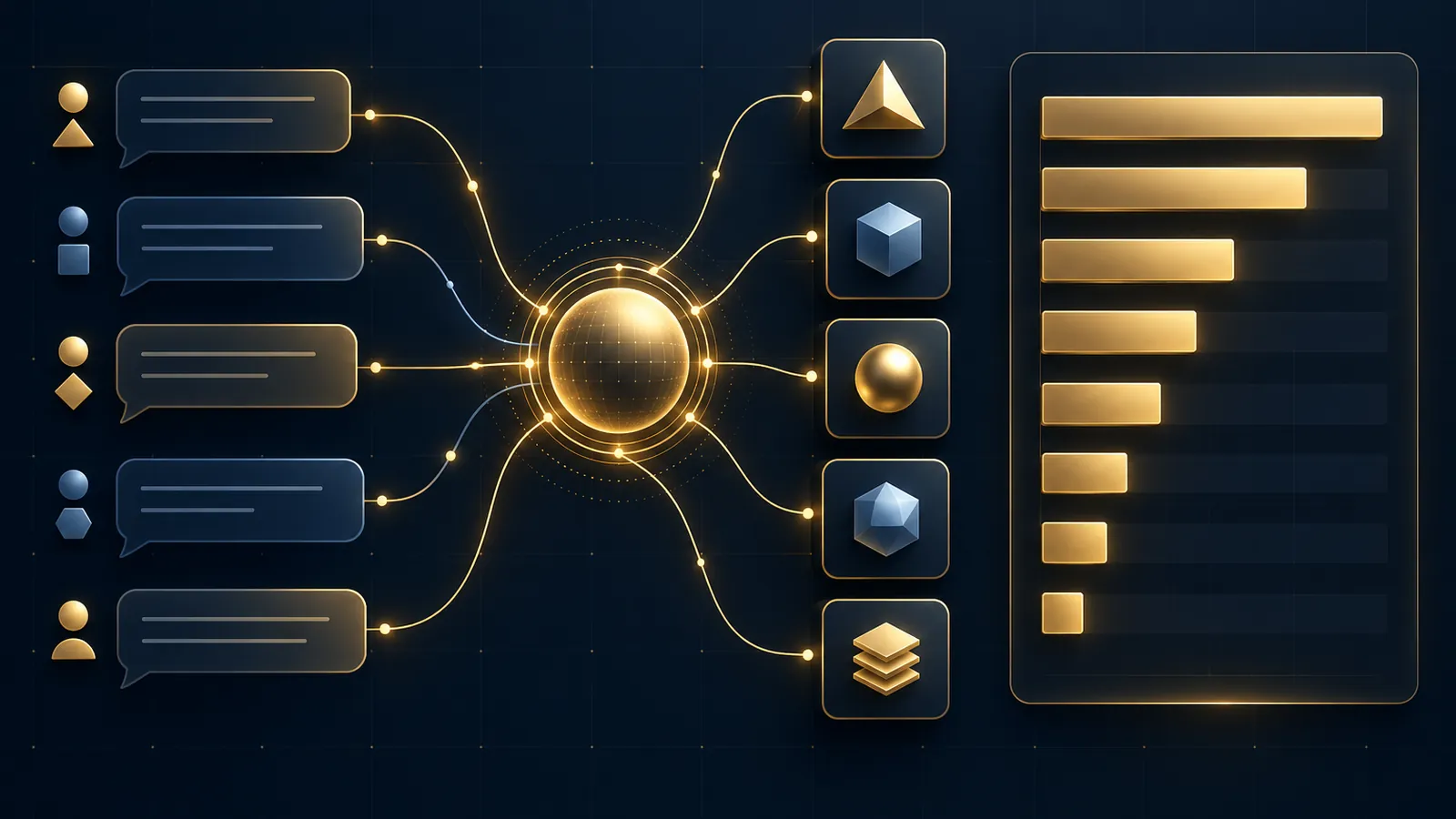
Grok Bot Slack runs on whichever model Grok Bot chooses for each task, so the useful question is not which model to pick but what the GoldieBench scores tell you to expect.
The Grok Bot FAQ are blunt: there is no model picker, and the choice can be a first-party SpaceXSI model or a third-party one, changing from request to request.
Below are the scores I read on goldiebench.com for the models closest to that mix, and what they mean for Slack work.
If you want help splitting your team's jobs between Slack and models you control, book a free SEO strategy session.
You don't choose the model behind a Slack reply
Grok Bot uses the backend model it judges most likely to deliver the best result for each task.
Users can't be routed to or away from a particular model, and usage views show Grok Bot usage rather than a provider or model name.
The FAQ names one example: a task can be routed to Opus 5.5.
So when a teammate @mentions your shared Bot in a thread, the model answering may differ from the one that answered the last message.
Your levers are the Bot's instructions, its skills, its triggers and its approval rules, documented in Shared Bots and Skills, routines and automations.
What GoldieBench actually measures
Every model on the bench gets the same fixed prompts, one shot each, with a single HTML file out, scored 0 to 10, per the models page.
That is a test of one-shot build quality: games, sims, visuals and pages.
It is not a test of Slack summaries, thread replies or approval behavior.
Read the scores as a signal of raw capability, not as a Slack-quality ranking.
The scores for the models closest to Grok Bot's mix
| Model | GoldieBench average | Scored tasks | Page I read |
|---|---|---|---|
| Fusion | 8.59 | 47 | /models/ |
| Hermes MoA | 8.17 | 47 | /models/moa |
| Grok | 8.09 | 47 | /models/grok |
| Claude Opus 5.5 | 7.57 | 50 | /models/opus55 |
| Grok 4.7 | 7.15 | 20 | /benchmarks/grok47 |
| Grok 4.6 | 5.95 | 20 | /models/ |
All figures were read on goldiebench.com on 31 October 2026.
The Grok rows are xAI models; the docs don't say which model Grok Bot uses for a given request, so treat them as reference points, not as Grok Bot's own score.
Grok: 8.09 average across 47 tasks
The Grok page lists an 8.09/10 average, a 256,000-token context window and 47 one-shot demos.
Its best-for list starts with workflows that need live X or Twitter context.
For a Slack Bot, that context matters most when a channel asks about what's moving on X today.
Its top scored builds include Twilightvale at 9.5 and Landing at 9.0.
Grok 4.7: 7.15 and rank #18 of 26
The Grok 4.7 breakdown shows a 7.15/10 average over 20 scored tasks and a board rank of #18 of 26 ranked frontier models, with data refreshed 2026-10-27.
The Grok 4.7 model page says it won 14 of 20 head-to-heads against Grok 4.6, which averaged 5.95 on the same briefs.
It also lists a 500,000-token context window.
Among the outside signals, Terminal-Bench 4.0 sits at 38.0%, which the page calls the weak spot xAI reports itself.
Two of its 20 builds died on load or never moved when played.
Claude Opus 5.5: 7.57 across all 50 tasks
Opus 5.5 matters here because it is the one model the Grok Bot FAQ names as a possible route.
The Opus 5.5 page shows a 7.57/10 average across 50 tasks and a 1,000,000-token context window.
It also says all 50 one-shot builds rendered with zero console errors.
Its best-for list reads: hardest agentic builds, whole-repo reasoning and frontier one-shots.
Where a model you choose fits next to the Bot
If a job needs a model you can name, run it outside Grok Bot and bring the result into Slack.
Hermes MoA scores 8.17 across 47 tasks on its model page, using a panel of Claude Opus 4.8 and GPT-5.5 merged by an Opus 4.8 aggregator.
The same page lists the trade-off: roughly 110 to 140 seconds per single-file build.
Fusion tops the models list at 8.59 across 47 tasks.
Use these for heavy one-shot builds, and leave thread questions, summaries and routine work to the shared Bot.
What the scores mean for Slack work
- A higher one-shot build score doesn't make a Slack summary more accurate; the trigger and the brief do.
- Slack failures usually come from broad triggers, and a busy-channel trigger can use a week of usage in a day, per the routine docs.
- Safety comes from approvals, not models: in a Slack thread only the person who asked can answer the Review an action card.
- Since every reply is billed to the person it answers, a vague request wastes that teammate's allowance whichever model runs it.
How to read a score gap for team chat
The gap between Grok at 8.09 and Grok 4.7 at 7.15 is close to a full point on the 0 to 10 scale.
On GoldieBench that gap comes from games that crashed or froze, not from weaker writing.
A Slack thread rarely asks a Bot to ship a single-file game, so that failure mode barely touches chat work.
What does carry over is context length: 256,000 tokens for Grok, 500,000 for Grok 4.7 and 1,000,000 for Opus 5.5, per their model pages.
Long channel histories and attached files fit more easily into a bigger window.
Since Grok Bot picks the model, the practical move is to keep requests focused so any model can handle them.
A setup that splits the work
- Plan check: Grok Bot comes with Premium, Super and Ultra, but not Plus (plan page).
- Share one Bot with your Cursor team and connect it through Bring to your team's Slack.
- Give it narrow Slack triggers and keep drafts on for anything external.
- Send heavy build jobs to a model you pick in your Agent OS, such as Hermes MoA; the AI Profit Boardroom trainings walk you through running it.
- Post the finished output back to the Slack thread yourself, or have the Bot draft the message for approval.
The facts that matter more than any score
Since v0.75.5 on 23 October, routines can run 300 times an hour in total and 200 times an hour each, per the Grok Bot changelog.
Since v0.77.0, Slack drafts show who they will notify, and auto-review cards stay open 30 minutes.
Since v0.78.1, a Team Bot routine that needs your connector asks in the Slack thread and tags you.
Those settings shape your Slack results more than a point of benchmark average.
Check them first whenever a teammate says the Bot gave a poor answer in a thread, and check the benchmark pages second.
For the Agent OS and the trainings that put chosen models next to your Bot, join the AI Profit Boardroom.
Also On Our Network
- Agent Operatorsthe four-step order for sharing a Grok Bot into Slack without the gotchas
- AI Income Deskwhether a shared Grok Bot in Slack pays off for a small team
- AI Tool Verdictan eight-point scorecard rating Grok Bot in Slack out of 10
- agentos.guidefive copy-paste prompts that let your Agent OS run a Slack Grok Bot
- aiprofitboardroom.comthe complete Grok Bot Slack guide on the AI Profit Boardroom blog
Let the Bot pick its model, put your effort into triggers and approvals, and book a free SEO strategy session if you want help planning your grok bot slack setup.
FAQ
Can I choose which model answers in Slack?
No. Grok Bot picks the model for each task, with no model picker, and the choice can change between requests.
What does Grok score on GoldieBench?
The /models/grok page lists an 8.09/10 average across 47 tasks. Grok 4.7 averages 7.15 over 20 tasks and ranks #18 of 26 on its benchmark page.
Does a higher benchmark score mean better Slack replies?
Not directly. GoldieBench scores one-shot single-file builds, so Slack quality depends more on the Bot's brief, triggers and approval rules.
Where should I run jobs that need a specific model?
Run them on a model you choose in your Agent OS, such as Hermes MoA at 8.17 on GoldieBench, then bring the result into the Slack thread.
Keep reading
 Grok Bot Teams + Which AI Models Matter: What Real GoldieBench Scores Tell A Team Using Shared Bots
 Grok Bot Routines: Which AI Models To Pair With Them, With Real GoldieBench Scores
 Grok Bot Plugins + Which AI Models To Pair With Them: Real GoldieBench Scores For Grok, Grok 4.7 And The Top Of The Board
🌐 Sister-site take: read this on agentos.guide